Showing posts with label Disaster. Show all posts

Wednesday, October 12, 2011

Post-Alarm Call

In this world, the one thing that's never in short supply is outrage. An endless parade of idiocy & atrocity is never further away than your TV set, and is sometimes as close as outside your window. This is honestly among the reasons for my recent "sabbatical": between the Libyan civil war; the ongoing atrocities in Syria; the latest terrorist attack in Mogadishu; fresh unrest in Egypt; the Monsoon-induced flooding that has claimed hundreds of lives in Pakistan, Thailand, and Vietnam; the ascension of the latest feckless whipping-boy to the Japanese Prime Minister's seat; Rick Perry's impression of a yo-yo; and, I dunno, Beyoncé plagiarizing avant-garde European choreography, I was stricken by total outrage-option-paralysis. So many things to be angry about, so little time!

In context of the true horrors listed above, that the theatrical reaction to Steve Jobs' death finally drew me back to my keyboard proves it's always the little straws that break the camel's back. I find some small comfort in knowing that I'm not alone.

But between every shiny, bloody distraction, it's too easy to forget that in much of the world, the dull struggle of daily life is still a struggle. Yesterday marked the seven-month anniversary of the March 11 disaster here in Japan. Months may as well be millennia in the 24-hour hypecycle, so even the domestic Japanese media has turned their attention away from those still stricken in Tohoku, as Takao Yamada angrily noted in the Mainichi on Monday:
Of utmost urgency now are the evacuation of children, decontamination, and the installation of becquerel monitors to measure radiation levels in food. But meanwhile, in Tokyo, we're talking about economic growth and the export of nuclear technology, as if what's going on in Fukushima is somehow irrelevant to us. That, I believe, is simply wrong.
To that end, I'm currently attempting to assemble a short radio documentary about the recovery effort in Tohoku.

This is where I need your help.

Since I'm pitching the documentary to a Canadian broadcaster, the piece needs to focus on Canadian citizens who live & work in Iwate, Miyagi, and Fukushima prefectures - those places hardest hit by the catastrophe. I want to focus not only on the disaster itself, but also its long-term & still-felt effects, the reconstruction & return to something like "normality", and governmental response to the disaster. That last notion could be, I think, the most instructive on how to proceed in Tohoku and future crises: not only are the Japanese generally dissatisfied with how their own government has reacted, there's plenty of anecdotal evidence that Canadian citizens felt more or less abandoned by their own government during a moment of desperate need. It's easy to see why, given that the bulk of the Canadian government's support to Japan was not monetary, or even military, but "moral".

So far, though, I've had little luck in finding anyone willing to speak about their experiences. If any of you reading this, through however many degrees of separation, know a Canuck in northern Japan who might be interested in sharing their experiences, please have them contact me by the e-mail address in the upper-right of this blog (under my profile pic). I'd be most grateful for their conversation.

In the meantime, it warrants mention that a friend & I organized a noise-improv gig back in March to benefit friends of ours up north. A recording of that show is available as a paid download, with all proceeds continuing to Red Cross Japan & other local charities involved in the recovery effort. As an album, it doesn't make for particularly easy listening, but these days, very little in Japan comes easily.

Tuesday, April 19, 2011

Everything Back To Norbal

The jaunt to Hokkaido was a pleasant vacation from the past month's mild panic & lingering paranoia. I'd visited the northern isle a few years before, so it wasn't totally unfamiliar territory - just different enough to unclutter the brainspace a bit. I gave myself a few extra days before my band's tour kicked off, so I got to enjoy Hokkaido's panoply of vaguely odd pleasures unhindered by driving schedules or sound-checks. A few old favourites were revisited - the Otaru Music Box Museum, Sapporo's Ramen Alley - but the highlights were stumbled-on surprises that, with the exception of bathing macaques, were of a distinctly unoriental nature: Japan's oldest concrete utility pole and the Lucky Pierrot burger chain! With its Edwardian-cum-Old West sideshow decor and demented half-blind mascot, Lucky Pierrot looks like a frighteningly dodgy proposition - a gastronomic Don Quixote. But I'll be damned if those weren't some of the tastiest, tongue-titillating burgers I've ever had, and for half the price of the mediocre, modestly-sized grub you get in Tokyo.

One burger joint I'd conversely advise against patronizing under any circumstances is Sapporo's Crazy Burger, not the least for its dull dentist-clinic decor. Their menu challenges customers with the 恐怖バーガー (literally "terrible burger") which, by the menu description, is only made daunting by a fish paddy and some extra jalapeño peppers. Accepting their culinary dare, I forked over ¥800 (around $10) only to be told they were out of buns and condiments and so was served two thumb-sized cuts of raw fish, and not just any ol' ichthyoid: Surströmming, officially the most foul-tasting food on earth. I discovered this only after having shoved both measly slices into my mouth. The taste was something like a beached whale carcass covered in cat piss. Or maybe sewer-snake braised in battery acid. I'm not sure. The shock to my digestive track was so rude that my whole physiology forbade the very notion of further ingesting anything more solid than air. My appetite had been raped. I'm just vaguely impressed I didn't vomit.

Much of the conversation on tour - as everywhere else - centered around the triple calamity of March 11. In Hokkaido, the effect has been almost entirely abstract. The tsunami that hit its coast was little more than a large wave. Also, the island operates upon a separate power grid; the dimming of neon facades has been out of solidarity as opposed to necessity. The only tangible impact has been the scarcity of certain items - specifically certain cigarette brands & Heineken beer - thanks to interrupted supply lines.

I suppose much the same is true back in Tokyo. Searching for evidence of the disaster, the devil is only found in the details: certain items are still rationed in supermarkets, gas prices are hiked, and commuter train schedules are bedeviled by rolling blackouts in certain suburbs. But then, if every daily trivium is touched by the catastrophe, that's not exactly an unperturbed normality, is it?

A fair number of those expats who fled during the madness of mid-March have quietly returned. The psychosocial schism isn't nearly as dramatic as, say, the Hollywood blacklisted versus the HUAC informers, but there's still some strain between those who stayed put and those who split. My post criticizing the "byejin" or "flyjin" who left the country ripped open an especially ugly fault-line in our immediate social circle. For my part, I've refused to ask anyone to take sides in the argument, but given the communicative embargo my "nemesis" has imposed against me, it unfortunately looks as though mutual friends will have to orchestrate engagements rather shrewdly to keep us apart.

It's interesting that another friend & I, who've been the most vocal in our censure of fleeing foreigners, are also the most explicitly socialist within our clique. Because of our politics, we likely see the disaster as an ideal situation to reconstitute the social framework of Japan. Never before has there been such an opportunity to forge lasting cooperation & compassion between the native population and the expat community. For all the times we've lamented the insular homogeneity of Japan, this is the moment when solidarity amongst Japanese & gaijin can transform the country into a more inclusive, diverse, and fluidly-identified culture. It's to our dismay & detriment that, instead, the hysteria & self-regard of many expats has pitched them in stark, unflattering contrast to the stoic endurance of the Japanese.

Friday, April 01, 2011

Inner Ear Balance

Earth Hour - a token gesture at best - doesn't mean much in a country rolled over by blackouts. Having lost 20% of its capacity, TEPCO is running dangerously near its maximum output and has asked for the public to curtail its electricity consumption. For their part, the Japanese have dutifully & promptly complied: tights belts are the new black. This new trend of collective restraint is the upside of that hive-mind passivity that recently emptied supermarket shelves and often drives type-A expats off their hinge.

I personally suspect the electricity deficit could be addressed merely by shutting down all the damned pachinko parlours. But otherwise, the obvious first sacrifice is Tokyo's famous forest of neon signs. A week ago, my band drove the width of the city coming back from a gig, and from the Edo river through to Shinjuku, Tokyo was a literal shadow of its former self. Friday nights are usually a parade of packed taxis jamming streets lined with sloppy drunks under a technicolour canopy; instead, we sped through a chaioscuro landscape haunted by the odd straggler searching for cabs that were all idling outside dimmed train stations. The hostile loneliness reminded me of the grim, grimy New York immortalized in After Hours or Night On Earth.

(Lest I be accused of bathos, let me refine the above description: Tokyo now looks less like Blade Runner on MDMA and more like... well, just any other city on the planet.)

Having shaken off the initial shock, we're starting to understand the medium- and long-term consequences of the disaster: the global consumer economy has been gut-punched by the disruption of Japanese manufacturing, and imports & exports will be unsteady until the Daiichi plant is solidly entombed in cement. Both of the above have direct consequences for those of us in Japan physically unscathed by the catastrophe: no beer and no new iPhone! The horror... the horror...

But this is where my general pessimism pays off. Should the patina of modern convenience completely peel and flake away, I'm ready. I've been anticipating the day when the lights go out and supermarket shelves are stripped bare since I first saw Mad Max. No tears or rending of garments from me, 'cuz son, it's go-time!

I want to be clear about the cut between pessimism & cynicism. I haven't spent my adult life glumly awaiting Armageddon because it's all fucked anyway - that is the joyless slouch of the cynic. My pessimism sits somewhere between Shöpenhauer's and Nouriel Roubini's: those of us lucky enough to inhabit the best possible part of this worst-possible world ought to enjoy it because it's too good to last forever. Every time I set out across this city, I'm filled with a marvelous hilarity. Should I ever have grandkids, how will possibly describe the lunatic animation of this place to them?

During the drive home with my bandmates last week, we had an amusing epiphany. Our singer had titled two songs - both written last year - "Plutonium" and "Atomic Age", the latter of which contains the couplet "I don't wanna meltdown/But this is really happening." Barely two years into his career as a language-mangling frontman and he's already giving Mark E. Smith a run for his money as rock's preeminent psychic. The drummer immediately demanded the singer start writing some happier goddamned songs before he kills us all.

It's been good to get back to gigging. Aside from restoring a sense of regular purpose, it kills the solitary paranoia of disaster to see friends and swap where-were-you-when stories. Next week, we're off to Hokkaido for a run of shows across Japan's northernmost isle. Nothing like a short vacation from the capitol to clean off the cold sweat & fear-spun cobwebs of the past three weeks.

But now another potential casualty of the disaster could be Japan's live music circuit. Not only have dozens of foreign acts (who bring in the big money) canceled their Japanese tours, but rolling blackouts pose a clear danger to the functional existence of many venues. In the interest of keeping the ecosystem healthy, we're overloading our live schedule. By playing the same city three times in two weeks, sure, we may split our audience for any given show three ways, but better to draw one-third of our audience each to three different venues than pack one club while leaving two others to languish.


This past Monday, I played an improv gig with Uozu, guitarist for hardcore abstractionists (and my favourite band in Japan) Z. This was only our second excursion into quadramplified chaos under the clunky moniker UOZEB, and though it was a hell of a lot of fun, I couldn't hear myself play a damned note all evening. This may have been because we were augmented by a guest drummer & violinist (who ran through more effects pedals than I did). Bedlam at 120 decibels, but all for a good cause: I recorded the show, and as soon as it's mastered, it'll be available as a paid download with all proceeds going towards the Tohoku relief effort. I'll have it all linked up here as soon as possible.

See you on the other side of next week, and meanwhile - stay outta Hong Kong.

Monday, March 21, 2011

The Drift


If Japanese streets are emptier than usual, it's more likely because of the sodden weather than fears of irradiation. Cabin-feverish though we may be, today's national holiday couldn't be better timed. Those of us lucky enough to live outside of eastern Tohoku are depeleted from a week of incessant dread - a hangover minus the happy hedonism that usually precedes the headache.

By now, the excesses of mass-media Cassandras appear obvious even to audiences abroad. The irascible Charlie Brooker did a marvelously caustic take-down of last week's sensationalism. Confessing to some cognitive dissonance from the barrage of conflicting analysis & reportage, Brooker succinctly nailed why all anchors & analysts ought to be taken with a metric ton of salt:
Like most of us, I've no idea whether the fear is exaggerated or not. All I know is that I'm having advanced atomic theory explained to me by people who, last week, were struggling to describe the colour of Kate Middleton's dress.
The chief concern remains assisting the stricken in Tohoku, but throughout the rest of the country, life has largely picked up where it left off ten days ago. From where I sit in central Tokyo, the most immediate threat to my well-being is the precipitous rise in coffee prices.

And so Japan has fallen below the fold. Fair enough that the eyes of the world have drifted elsewhere. Sectarian violence continues in Côte D'Ivoire, the West continues its feeble bet-hedging regarding the democratic uprising in Bahrain, and then of course there's that other oil-rich autocracy descending into blood-swamp anarchy: Libya. Having been a second-banana boogieman for forty years, Qaddafi is finally the world's top-billed despot. If the wanton slaughter of his own citizens wasn't enough to turn news network talking heads, then NATO nations' swift assault on Libya guarantees round-the-clock coverage. After all, when was the last time the French took the lead militarily? That itself is news-worthy.

The speed with which France attacked Libya while fleeing Japan seems paradoxical, but it's all part of Sarkozy's renewed effort to appear authoritative in the run-up to next year's election. Sarkozy's credibility hinges upon his actions in Libya: not only was Foreign Minister Michele Alliot-Marie forced to resign after vocally supporting the since-deposed Tunisian regime, Qaddafi's son is now claiming to have contributed to Sarkozy's 2007 election campaign.

Furthermore, the French government was "stung by criticism they were slow to react to the crises in Egypt and Tunisia." Not only did this ensure military dick-swinging that would be lauded as bold & assertive, it explains why French citizens were the first to be evacuated from Japan following the hydra-headed disasters of March 11. Sarkozy could afford to be ambivalent towards the tumult in Tunisia and Egypt, but he would not survive being perceived as indifferent to French citizens caught in one of the greatest natural disasters in recorded history. However, now the evacuation seems premature and even the aerial assault upon Libya has been called "impromptu." Instead of swift-thinking and determined, Sarkozy risks appearing like (in The Economist's words) he is "policymaking by impulse and improvisation."

Meanwhile, as the newshounds sniff out new scents, a different kind of drift may be occurring in Japan: intercultural estrangement. This is arguably the first Japanese disaster with international consequences since the Second World War, a side-effect of which will be a warp in Japanese-foreigner relations. As countless others and I have noted many times, Japan is arguably the most homogeneous & xenophobic of developed nations (which is really saying something). As such, it's a delicate high-wire act for both Japanese and foreigners to engage each other's culture without retreating to unflattering stereotypes. The foreign community simply isn't large enough to stake its own turf unapologetically, and the Japanese have to tolerate - however grudgingly - those among them who are different.

So it does neither side much good when foreigners collectively lose their cool and stampede the exits like laggard rats. The libidinous pessimism of western media has been perhaps the biggest push out of Japan:
The heightened sense of fear may be due to foreigners consuming an "unfiltered diet" of panic-stricken Western news and worries that the domestic news isn't trustworthy.
Unfortunately, this media-spawned panic spreads virally from foreigners to the Japanese too. After all, when 3,000 Chinese from Tohoku alone have gone home, and the embassies of Japan's major allies - France, Germany, and America - are all encouraging their citizens to evacuate, of course the Japanese are going to wonder what decisive information foreigners are privy to that they're not. Widespread mistrust of the government's candor has persisted since they took several hours to issue a statement after the first explosion at the Fukushima Daiichi nuclear plant, leaving a vacuum the collective imagination filled with all manner of apocalyptic fantasy.

One of my Japanese bandmates told me tonight that I've become the canary-in-the-coal-mine for our circle of friends. During the peak of last week's confusion, he received a phone call from a friend outside of Tokyo:
"You're alright? Is your girlfriend okay?"
"Yeah, we're both fine."
"And Kentaro? Satoshi?"
"Yeah, they're fine too."
"What about Seb? Is Seb still in Tokyo?"
"Uh, yeah."
"Whew! Well, then, we've got nothing to worry about!"
It's nice to know that I'm thought of as a solid judge of circumstance. But the quickly-decamping foreigner has fast become such a stereotype that it's earned its own ignominious bilingual nickname: the "bye-jin". Clearly, the expat community suffers a considerable deficit in credibility. Ergo, another friend has wisely made his cataclysmal barometer a group of old ladies at his local community center - all with long memories and life experience to match. Once they begin to get rattled, it might be time to get the fuck out of Dodge.

But for now, abandoning a country in its darkest hour does not leave much in the way of goodwill. I wonder how little those that have left really have invested in their lives here, and I can't imagine their Japanese friends will be terribly impressed with their fitful selfishness. If actions speak louder than words, then the point at which someone tucks tail and runs speaks with a megawatt bullhorn. The one possible benefit is that those of us who've stuck it, who've neither headed home nor even withdrawn to some western Honshu hotel, could earn some extra respect from the locals for our solidarity & stoicism.

Who knows. Depending on how this whole episode finishes, our stoicism might very well end up being stupidity & sloth.

Saturday, March 19, 2011

Situation Normal, Albeit Fatigued & Uncanny

The mouse-click marathon through a dozen different news sites is now as essential to our rise-'n'-shine ritual as the first cup of coffee. "Welcome to day eight of our live coverage," the BBC live feed greeted me yesterday. Wow, already a week? It feels more like an impossibly protracted bad day. Imagine how long it feels to the folks up north.

Given the tenuous & mercurial situation at the Fukushima Daiichi nuclear reactor, we're all but enslaved ourselves to the news cycle. By the time we've checked our various e-mail accounts, friends' blogs, live streams, and embassy websites, it's time to recommence the rotation - after all, something might have changed in the past four minutes! But a snake can only swallow its tail so far before it wants to vomit. The cost of constant connectivity is ceaseless stress. This paranoia has prompted a mass exodus of foreigners fleeing Tokyo for Kansai and Kyushu - which strikes me as an ill-advised strategy. Not only are hotels out west packed like sardine tins, but what will happen if (god forbid) a major aftershock strikes the other side of the country? The ensuing panic & local strain upon resources would be double what it would otherwise be.

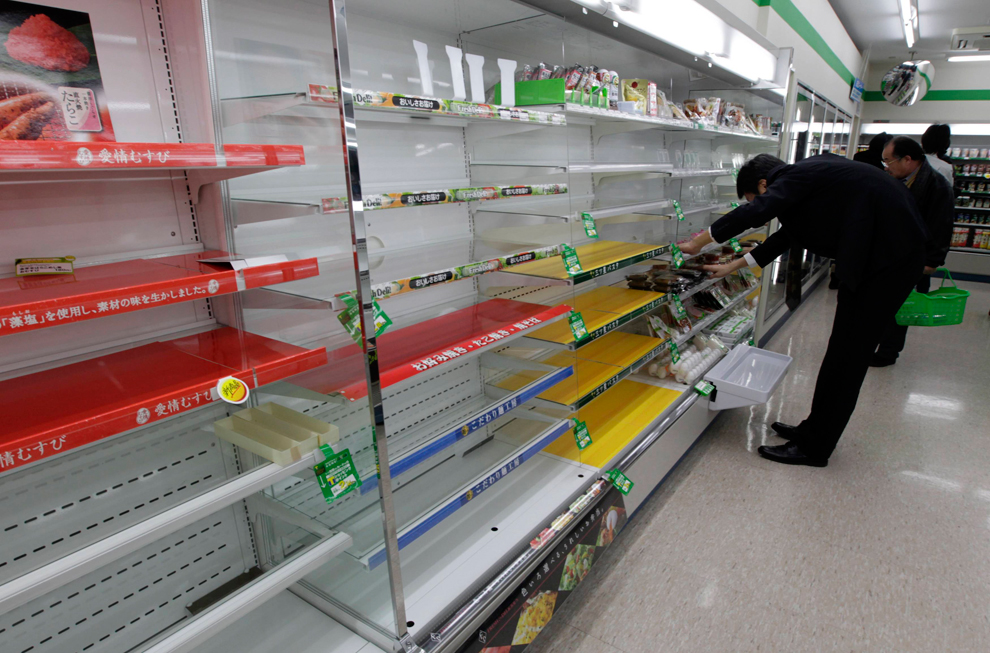
We've already seen how quickly support systems can be stretched to the breaking point by a shell-shocked populace. The above photo, snapped this past Tuesday by my friend Lee, captured a sight common to every convenience store & supermarket in the Tokyo metropolitan region. Everyone now has their pet story of some asshole panic-buying. I saw two young women march out of my local mini-mart with eight loaves of white bread and a half-dozen boxes of Frosted Flakes. A day later, a friend witnessed a single woman lugging 15 kilos of rice through checkout. My neighbour Jonny watched one man sweep a whole shelf clean of tofu, and later saw a couple wipe another store out of their entire supply of diapers. (Maybe all that Wonderbread was giving them the sugar-shits?)

Selfish shoppers, however, have marked the nadir of post-catastrophe panic in Japan. Many an overseas commentator has noted the lack of looting, rioting, or other such bedlam that typically rides disaster's coattails. Explanations for the near-undisturbed order of Japanese society have tended to note the culture's homogeneity, immense pride, and innate collectivism. (There's also the ubiquity of authority figures, both legal and, er, other.) But Jonny feels these interpretations ignore the taciturn unease that can be felt around the city: "This feels more like resignation than stiff-upper-lip stoicism to me." This would explain all the panic-buying minus the panic; it does feel as though we've surrendered to the dull inevitability of the worst-case scenario and are merely acting accordingly.

For sure, Japan has suffered a miscellany of worst-case scenarios over the past century. The relative calm of the Japanese amidst misadventure may be part Pavlovian, part harrowed familiarity, but it certainly doesn't stem from an abiding faith in state power. Mistrust of the government has clearly crested when even MTV is accusing Prime Minister Kan of diffidence. Emperor Akihito's five-day-late* televised address provided the perfect analogy to the country's administrative & corporate leaders: in a suit more rumpled than Japan's topography sat an aged man, shielded by privilege and power, with a prehistoric grasp of P.R. offering platitudes instead of strategic substance.


There's certainly panic to be found if you're looking for it - just not amongst the Japanese. Thousands of foreigners have either fled westward or are seeking safe passage out of the country. On Tuesday, the French were the first to loudly shit themselves by calling for their citizens to evacuate; the Germans weren't far behind, spurred by scaremongering news sources like Der Spiegel.

Which brings me to the current bête-noir of every foreign resident: alarmist mass media. To hear it told by the Western media, everyone not yet dead is vomiting blood from radiation poisoning and this airborne death will gradually blanket the globe, crippling mankind and leaving us vulnerable to invasion by Venusians who will kill your grandmother and punch your baby in the face.

By now, every foreigner I know has received a frightened & tearful phone call or e-mail from abroad, pleading with them to leave the country. What else would our families think when every report suggests an outcome of, at best, a cancerous time-bomb, or at worst, "bigger than Chernobyl." Consequently, there's been a massive push-back amongst local bloggers to combat media delerium, emphasizing the relative (and it is relative) normality reappearing across the country. After all, how immediately desperate can the situation be when Japan's already been replaced by Libya, Bahrain, and Côte D'Ivoire for above-the-fold coverage?

Yesterday, my wife & I strode out across Western Tokyo to assess the level of local pandemonium that CNN et al. were reporting.

As you can see, it was utter ataxia, total societal dissolution. Granted, there's an uncanny pall created by the number of still-shuttered shops; electrical shortages have dimmed the neon glare and silenced commercial loudspeakers. But by the most important measures, life continues undaunted.

The most infuriating side-effect of the nuclear neurosis is that it's distracting from the true disaster still unfolding in Tohoku. So displaced is the world's worry that donations are currently a measley sixth of the amount pledged towards the Hurricane Katrina relief effort. Of course, playing up the nuclear problem appeals to the solipsism & self-interest of the West: what happens when/if the radiation hits there? Could a similar catastrophe strike their nuclear facilities? News outlets can't sell ad placements at premium prices while reporting that the Fukushima meltdown is strictly a localized danger. Meanwhile, the American government (and others hoping to avoid Katrina-style embarrassment) is covering its ass by overplaying the urgency of the situation - while nevertheless requiring disaster-stricken American citizens to pay for their own evacuation. Consequently, as opposed to helping the suffering in Tohoku, many in the West are crying narcissistic Chicken Little, weaving the calamity into their own twisted agendas, or retreating into masturbatory navel-gazing.

The bottom line is this: there are 50 selfless workers literally giving their lives to ensure that the nuclear problem remains a limited & local one, while over 10,000 victims remain unaccounted for and 380,000 people have been left homeless. There is little, if any, clean water, fuel, or electricity in Tohoku. These people need help, not impotent hand-wringing.

As for the rest of the country, we're no longer waiting for the other shoe to drop. We've got our lives to get back to, though after a full week of confusion & tragedy, it's nice simply to stop and smell the roses. Or ume blossoms, as the case may be.

* - Interesting trivium: this is also how long it took George W. Bush to reach New Orleans following Hurricane Katrina.

Sunday, March 13, 2011

Pick Up the Pieces

Well, I was about two edits away from completing posts about the ongoing guitar-solo battle and America buttoning up its brownshirt - but given current local circumstances, both those topics seem, if not irrelevant, low-priority.

When the quake hit Friday afternoon, it took me about 20 seconds to realize this was not an average tremor: instead of the normal side-to-side shimmy, the ground was undulating in an unnervingly fluid manner. That it hadn't stopped after 20 seconds was an even worse sign. Not wishing to die pancaked under concrete, I dashed out into the street. I couldn't immediately tell quite how frightened I should've felt: my neighbourhood is populated largely by stoics, slackers, and seniors, all of whom were stolidly standing around watching the streetlights & stop signs rattle and groan. Taxi cabs and bicyclists obstinately struggled to steer straight as the asphalt warped beneath their wheels. Was this a fucking disaster or not?

Once the shaking stopped, I ran back inside to find my apartment totally intact - a minor miracle, considering its seemingly-shoddy construction and our laissez-faire approach to storage. Returning to my computer, I noticed my Caltech scientist friend had just logged on. I broke the news, to which he replied with the appropriate amount of incredulity:
me: Dude, we just had the biggest earthquake I've ever felt.
Scientist Friend: !!!
you ok?
hasn't shown up on my feed yet
me: No, I mean like JUST hit.
Scientist Friend: oh shiiiit
We then spent the better part of an hour swapping links & updates as information began flooding in... 7.9, epicenter near Sendai, 8.8, tsunami warnings, 8.9, the largest earthquake in Japan's history. This was a fucking disaster.

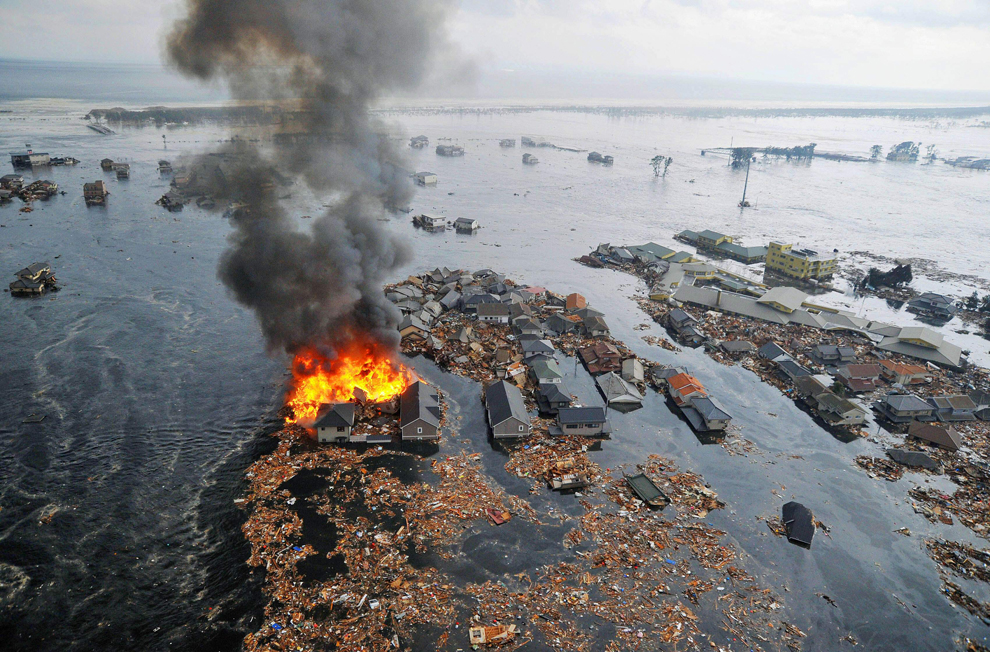
Wow, what an grossly unsuitable turn-of-phrase I just used. "Flooding in..." Less than an hour after the quake, I sat slack-jawed & stupefied watching live coverage of tsunamis bulldozing whole towns along the Pacific coast. There's no point in trying to describe the sight. Not only has the 24-hour news cycle chiseled these images into everyone's retinas, but there's no joy in, uh, eloquently and succinctly relating the deaths of hundreds, maybe thousands of people.*

Having had my fill of calamity-porn infotainment, I stepped out for some fresh air. The streets were eerily empty for a Friday evening. With mass transportation at a stand-still, everyone was still stuck at work. The signs of catastrophe were quietly obvious, as most shops were either shuttered or sweeping up their shattered wares. (As unpleasant as it is clearing away smashed liquor bottles or ceramics, I can't imagine how exasperating it must be to tidy up a pachinko parlour after an earthquake - ball bearings all over that sumbitch...) A couple of billboards threatened to fall from their perches. The ferroconcrete facade of one shop had collapsed, exposing the building's dainty wood skeleton. But mercifully, Koenji had escaped the quake largely unscathed.

Later Friday night, my wife & I were interviewed by CBC Radio as "eyewitnesses" to the disaster. We were dramatic enough to keep our account interesting, while at the same time emphasizing how little we could justifiably complain. Our misadventure wasn't a pale shade of the terror experienced by residents up north. We were speaking from a heated apartment with hot coffee and clean socks - how bad off could we really be?

Yesterday was a gorgeous blue-sky day with the resiny chill of early spring in the air. A friend & I enjoyed a lengthy hike across Western Tokyo to cure ourselves of cabin fever and the lingering stink of apocalyptic presentiment. However, whatever cheerfulness we'd won during the walk evaporated upon arrival at a friend's house, where we learned that the Fukushima Daiichi nuclear reactor had just popped its top. Our immediate course of action was obvious: start drinking like a bastard and pray the jet stream would whisk any & all radioactive toxins up over Siberia, because fuck reindeer, man.

I was spurred to an early retreat home by sudden rumours of rolling blackouts and supply shortages. I must have been slow off the blocks because already there was not a slice of bread, not a carton of milk to be found in any shop I entered. Faced with such a depleted selection, many shoppers had opted for foodstuffs that would strike a penniless college student as grossly unhealthy: boxes of Frosted Flakes, microwave pasta, chocolate-covered potato chips, and enough six-packs to make the U.S. marine corps plotz. I suppose diabetes kills you slower than starvation.

Today, further steps towards normalcy have been made. Electricity, gas, and water are still running. Bread & milk are back on the shelves and the trains are on time. But again, I speak from the privileged position of the resource-greedy capitol almost 400km from the epicenter. The slowly-unfolding horror of nuclear meltdown continues, and the people of Tohoku are in desperate need of assistance. If you're so inclined, donations can be made to the Red Cross and Globalgiving.org. It may seem unlikely that a first-world nation would so be in need, but remember: this is a first-world whose debt is over twice the value of its GDP with a population so aged that it makes the SCOTUS look like spring chickens. If the West still wants someone to manufacture semiconducters and service the American national debt, then help is absolutely necessary.


* - Having neither a television nor the interest, I haven't really watched CNN outside of hotel rooms until this weekend - wow, I had no idea they were such a lousy network. Not "lousy" meaning "transparently propagandist," à la Fox News, just straight-up bad. They've got analytical prowess of a 10-year-old and the emotional tenor of Woody Allen after a bout of heavy drinking. The spectacle will no doubt reach its faked climax Monday night when Anderson Cooper will stroll around the demolished mise-en-scène where the news used to be, feeling the story at us. Ugh.

And I swear, come Monday, if Stewart or Colbert falls back on one goddamned Godzilla joke...

Friday, March 11, 2011

All Shook Up

Well, I'd have a lot more to say about this if there weren't still aftershocks rattling my apartment. Watching live footage of tsunamis wipe whole towns off the map in Miyagi prefecture. Absolutely terrifying. (Roland Emmerich really is a fucking pornographer, isn't he?)

8.8, they're saying - larger than the Great Hanshin Earthquake of '95, one of the largest in recorded Japanese history. Carl, hope all is well down your end of the country.

This planet is bullshit, man.