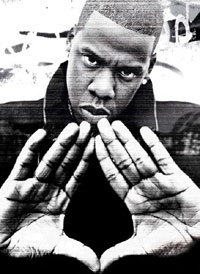
He has risen! Well, it looks like something's a-risin' at any rate...
All the best to ye & y'all's, people of earth. Shalom aleichem & A-Salamu Alaykum as well.
He has risen! Well, it looks like something's a-risin' at any rate... As the recently-late, formerly great Christopher Hitchens once said, travel - contrary to popular belief - narrows the mind, in that it diminishes difference & spotlights repetition. So it is with the touring musician: the more gigs you play, the more other bands you see, the more other bands you talk about and listen to... the more everything starts to sound the same. This is why so many stalwart musicians are crusty chauvinists guarding the carved-in-stone conventions of their respective genre: they've had to retreat to only the most elemental, primordial iteration of what they love(d) about music to feed whatever flagging enthusiasm they have left for the art form.
 Well, the second-craziest despot to rule a third-world autocracy has become the newest member in Ozymandias' Infernal Big Band. That is, he's dead. Neither will he be missed, nor will anyone hesitate to celebrate his demotion to mere worm-meal as Jong-Il's death is unencumbered by gruesome criminal circumstance. Good ol' fashioned natural causes as opposed to, say, occupational hazard.
 A Lamborghini, two Mercedes Benz, and eight Ferraris were involved in a high-speed pile-up on a rural highway in Yamaguchi prefecture, totaling the cars and sending ten people to the hospital.
We didn't use the word "system" but we very much thought of the whole group, of ourselves as connected - that there was a group sense, a group feeling. That was our whole purpose: to be fully connected to each other and to have this group sense of the organism of the many who act as one. ...It would be like a dance, where we're creating a new kind of society, freeing each person to be fully themselves in the group. But we're all affecting each other at all times, like an organism of many who act as one.Now let's skip ahead again to about 54:15 to hear what happened to these hierarchically-flat proto-societies:
[The communes] all failed. Most lasted no more than three years, some for less than six months, and what tore them all apart was the very thing that was supposed to have been banished: power. The commune members discovered that some people were more free than others. Strong personalities came to dominate the weaker members of the group, but the rules of the self-organizing system refused to allow any organized opposition to this oppression.Molly Hollenbach elaborates:
...The very rules that kind of set up this egalitarian group resulted in the opposite of the dream. They resulted in creating a hierarchical structure in which some could be dominant over others... because everyone is not equally powerful in their voice against one other person.This returns us to that Baudrillardian place wherein desire and power are interchangeable, and therefore desire has no place in the schema of power. The personal is the political, but not in the sense usually meant.
 While I've a grudging respect for the hacktivist swarm Anonymous, I can't say I particularly trust them. I don't trust acephalic crowds in general. "People like Coldplay and voted for the Nazis. You can't trust people." Especially people who've chosen, as their anarchosyndicalist hood ornament, the corporate depiction of a mercenary Papist who attempted to establish an English theocracy. Well thought out, indeed.
 For those of you who haven't the time to peruse works of Philip Zimbardo, I'd point you to Derren Brown's recent special, The Game Show, a succinct & dismaying experiment in mob mentality. As Brown explains:
[Deindividuation] is what happens when people become anonymous members of a crowd, which allows them to behave in a way that goes against their moral code. It's a large part of what turns normal people into internet bullies, rioters, football hooligans, and encourages reality TV audiences to victimize contestants.This deconstruction of a subject's sense of personal responsibility begins as the individual becomes physically subsumed in a large group, and is aggravated by even the simplest disguising of their personal features - say, a black hoodie, bandana mask, or the plastic semblance of Guy Fawkes.
 Now, I'm not saying that Anonymous' volatility & potential for hard resistance are a bad thing. As Disaster Notes explained earlier, it's still very early days for Occupy yet it's already minimizing its more radical ententes in favour of some latté-hipster version of Satyagraha. In light of recent developments, the movement's apparent commitment to moderation could very well prove suicidal. Several weeks ago, the Oakland PD's attack on protesters was a one-off aberration after six peaceful & dignified weeks, allowing Occupiers to feel smug with the relative ease of their success thus far:
While the cops may have the guns I think they’re starting to realize they don’t have the power - they’re on the wrong side of history. When they start seeing their neighbors, children and parents standing in the front lines of the OWS movement, their loyalties will shift and shift swiftly.But now the riot gear's out, court injunctions are flying, and the streets are foggy with tear gas and pepper spray. It would behoove the #Occupy movement to remember that it's up against the full authoritarian might of oligarchs who start wars to boost their GDP, cheered by a complicit media and a frighteningly large portion of the selfish, consumerist public. Unleashing Anonymous & the Black Bloc may be a PR nightmare - Occupy's "nuclear option" - but it's an option the movement needs available to them.
First they ignore you, then they laugh at you, then they fight you, then you win.It would appear that Occupy has graduated to the stage wherein they are being fought. As unpalatable as Anonymous & the Black Bloc may be to the more genteel members of the movement, it may serve them well to have comrades who are more than willing to fight back.
 I realize it's a bit cheap of me to take pot-shots at the Occupy movement from the comfort of my boho-Tokyo bunker, so it was instructive to read Disaster Notes' cautiously pessimistic perspective from inside Occupy Austin. Not that I take any particular joy in knowing that the Occupations are as meekly reformist & restrictively managerial as I suspected. If you too are concerned that the ossified moralism of the Occupation's milquetoast middle-mass threatens the very "diversity of tactics" they claim to embrace, then Disaster Notes' full critique of General Assemblies is required reading.
That the demands conspicuously reject proposed mention of humanity’s rights, democracy, justice, and politely refuse any language that might bring to mind the ruling class’ lawlessness, barbarism and mercilessness, tends to nudge the discourse in the most dangerous direction, toward the legitimisation and indeed inevtiabilisation of reaction and toward faciliating the project of containing this revolt in the guise (flimsy enough, and usually disavowed) of securing some concrete gains while the getting is good.On an immediate, practical, and modest scale, all of this suggests that perhaps the most appropriate slogan for the Occupiers is - with minor amendment to an existing favourite - "Citizens United will never be defeated!"
Now at the start, these demands were proposed alongside a list of demands for an end to the state’s violence and terrorising and lawlesness and debt amnesty. That these didn’t make the cut is very signficant, and shows how “compromise” can transform a radical agenda not into a reformist one but into a reactionary gain for the ruling class.
 Almost two months have passed since the inception of Occupy Wall Street, which is more than enough time for everyone to take sides according to whether or not they sympathize with anti-corporate collectivism. Thus far, public opinion (though hardly unanimous) is more supportive of OWS than its Old Testament-meets-Wall Street libertarian dopplegängers, the Tea Party. This is meaningful because OWS and the Tea Party cannot be arbitrarily substituted for one another. True, they're both nominally anti-establishment populist uprisings, but that's as revealing as remarking that Jim Jarmusch and Chris Columbus are both successful caucasoid filmmakers from Ohio. Only the most facile & disingenuous among the commentariat pretend there's meaningful similarity between OWS and the Tea Party - a comparison so paper-thin that it can be debunked in about nine bullet-points augmented by flashy graphics.
 So far, I've been conspicuously silent about Occupy Wall Street, both online and off. After all, it's difficult to debate tactics & policy when there's little evidence or exercise of either: the very term "movement" implies momentum and direction, neither of which OWS has. The fraternal occupations that have sprouted around America & across the Atlantic are growth, for sure, but less snowballing locomotion than an entropic clustering of mass. The greater the Occupiers' numbers (or the greater the appearance of their numbers), the safer & more attractive it is for others to join their ranks. The Japanese have a saying: the more people running a red light, the less there is to fear. (Evidently, the Japanese have been to Baltimore.)
 Colbert too noted that they "seem like a cult."
It is hard to say how many Socialists saw clearly how useful reform was to capitalism, but in 1912, a left-wing Socialist from Conneticut, Robert LaMonte... suggested that progressives would work for reforms, but Socialists must make only "impossible demands," which would reveal the limitations of the reformers. (A People's History of the United States, p.354)That is, of course, assuming that Occupy Wall Street are sufficiently radical or ambitious to want something other than merely a kinder, cuddlier form of global capitalism.
 This took me aback, not only because I've neither seen nor heard of such open antisemitism in Japan, but especially because I'm not Jewish.
 Death, it's been noted, is no surprise. And on a planet packed with 123 people per square mile, the numbers dropping by the day are dizzying. Still, it feels like I wake every other day to find some globally-important figure has slipped - or been shoved off - this mortal coil. A Saudi prince here, an asshole billionaire there. But I was thoroughly unprepared to begin Friday being gawked at by Qaddafi's droopy kabuki corpse-maw. Put me right off the strawberry yogurt I was eating for breakfast.
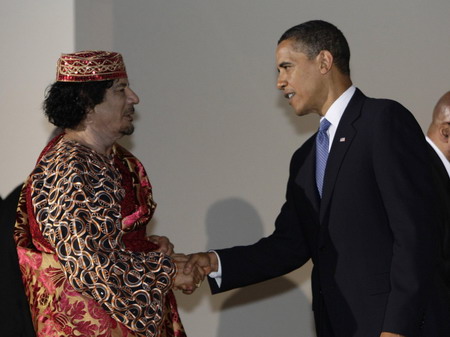 Same as the old boss.

 Care to guess which one came first? Here's a hint: one was a meticulously constructed masterpiece of elegiac beauty, and the other an anonymously cookie-cutter rehash of sub-Sly Stone funk with a snare sound thin enough to give your eardrum papercuts.
 In this world, the one thing that's never in short supply is outrage. An endless parade of idiocy & atrocity is never further away than your TV set, and is sometimes as close as outside your window. This is honestly among the reasons for my recent "sabbatical": between the Libyan civil war; the ongoing atrocities in Syria; the latest terrorist attack in Mogadishu; fresh unrest in Egypt; the Monsoon-induced flooding that has claimed hundreds of lives in Pakistan, Thailand, and Vietnam; the ascension of the latest feckless whipping-boy to the Japanese Prime Minister's seat; Rick Perry's impression of a yo-yo; and, I dunno, Beyoncé plagiarizing avant-garde European choreography, I was stricken by total outrage-option-paralysis. So many things to be angry about, so little time!
Of utmost urgency now are the evacuation of children, decontamination, and the installation of becquerel monitors to measure radiation levels in food. But meanwhile, in Tokyo, we're talking about economic growth and the export of nuclear technology, as if what's going on in Fukushima is somehow irrelevant to us. That, I believe, is simply wrong.To that end, I'm currently attempting to assemble a short radio documentary about the recovery effort in Tohoku.
 In the meantime, it warrants mention that a friend & I organized a noise-improv gig back in March to benefit friends of ours up north. A recording of that show is available as a paid download, with all proceeds continuing to Red Cross Japan & other local charities involved in the recovery effort. As an album, it doesn't make for particularly easy listening, but these days, very little in Japan comes easily.
 So reality took precedence over my online presence for the past couple of months. A significant factor was that my band's current effort to release a record had turned into a blunder-plagued clusterfuck. (You know you're in trouble when your contact at the record-pressing plant is an accountant, not a technician.) But the bulk of my time offline has been on the road: my band has played more shows over the preceding month than we did all of last year. However, it wasn't simply that incessant touring kept me away from the computer and that explains my absence; there was a particular phenomenon recurrent on the road that made me want as much distance from cyberspace as I could get.
 But that's simply a dull annoyance. What I find disturbing is, thanks to the Japanese fondness for interminate & omnivorous tweeting, I've been assimilated into the Twitterverse without even trying. This past July, I was chatting with some acquaintances after a show in Nagoya. In the midst of the usual catch-up chit-chat, one of them asked me, "So how did you like your lunch? It looked super-American!"
 This was only first of what have become regular intrusions on my quotidian activities that I'd like to think were autonomous & anonymous. Last week, I arrive in Nara after an overnight drive to discover that a fellow traveler had shared a snapshot of my slumbering form with his 1,500 Twitter followers. This isn't to say that on-the-road naps & snacks are embarrassing in & of themselves, but it's upsetting that even such boring & inconsequential activities cannot escape the all-seeing eye of the electronic multitude.
This whole phenomenon, which seems to express a general individual and collective advance, rewarded in the end with embodiment in institutions, is ambiguous in its meaning and one might, as it were, see it as representing quite the opposite: there is no right to space until there no longer is space for everyone, and until space and silence are the privilege of some at the expense of others. Just as there was no `right to property' until there was no longer land for everyone and there was no right to work until work became, within the framework of the division of labour, an exchangeable commodity, i.e. one which no longer belonged specifically to individuals.This is certainly why arguments about the "right to privacy" have become more commonplace & heated concomitant with the rise of the internet & global telecommunications. As opposed to privacy of physical property (the long-enshrined fundament of liberal democracy), privacy of deed & thought are of greater value & concern the more impossible they become under the ever-widening purview of the self-imposed surveillance state.
 Come December, I'll be curious to see whose death ends up earning more year-in-review ink: that of Osama Bin Laden or Steve Jobs. For now, I just feel bad that Bert Jansch was robbed of his last moment in the spotlight.
 Lest we forget that Apple is a corporate behemoth whose liquidity exceeds that of even the world's largest national economy. Lest we forget that Apple is a technocratic Goliath which dodges corporate taxes and whose idea of "healthcare coverage" extends to suicide-prevention nets but barely any further. Unlike his oft-maligned doppleganger, Steve Jobs is not a philanthropist - he's a corporate padrino whose brilliance lies less in innovation than elaboration & refinement - making borrowed ideas better. Apple's very first personal computers (the Lisa and the Macintosh) were little more than liberal imitations of the Xerox Alto. Similarly, Jobs did not invent a GUI platform to (re-)distribute digitized music, but he did figure out how to monetize one.
 At least the UK got to watch the guys from Peep Show make smug pricks of themselves.
There is a creeping sense of someone pretending to have the emotions that are expected of them. And in this way hiding their true feelings even further below the surface. Or maybe the truth is even more disturbing - that there are lots of things that people live through and experience that they just don't have emotions about.As irrational psychic ephemera, emotions are difficult to understand and even harder to reproduce convincingly - particularly positive, sympathetic emotions. This is why tearful confessions & expectorating fist-fights became mainstays of daytime television far earlier than the joyful hug-orgies & triumphal backslapping of more recent shows like The Amazing Race or American Idol. So how did gushing exuberance become part of the public's expressive mode? Curtis points to the rise of "self-help" and collaborative craft shows like Trading Spaces and its British counterpart, Changing Rooms:
I think the man that really brought the hug into British television in a big way was the producer Peter Bazalgette. His genius was to spot that the idea of transforming yourself as a person could be intimately linked to transforming the things around you - starting with the rooms in your house.Steve Jobs understood this perfectly. By emphasizing his products' artful design, and by casting them as tools of creative composition, Jobs enabled his consumers to feel they were more fully-realized, expressive individuals thanks to him.
I think the first real hugs of these kind began in the series Changing Rooms in the mid 90s.
The original revolutionary idea had been that by changing yourself emotionally as a person you would then change society. Bazalgette created an easier and quicker variation. By simply changing the physical things around you - you could then change your inner feelings and became a better and more expressive human being.
Wallpaper as redemption.
 What I find disturbing is that, by surrounding themselves with beautiful expensive objects that encourage a melodramatic solipsism, people are encouraged to construct & occupy their own private fantasy wherein the crueler aspects of reality are not allowed. No one wants to feel bad. No one wants to struggle with criticism, dissent, violence, or acrimony. This relentlessly positive self-regard creates the illusion of a cozy but false consensus: by engaging only with the familiar & agreeable, we diminish our ability to cope with difference. Think different, but not so different that it unsettles you.
 About to haul this donkey-cart of ill-begotten thoughts back onto the trail and keep moving. Please excuse the cobwebs.
 A sad day for Canada as the country loses its finest politician & a genuinely decent human being aside: rest in peace, Jack Layton.
 The second I go off the grid, several new holes erupt in civilization's creaky, buckled hull. A delusional white supremacist single-handedly shell-shocks Norway; England explodes; and Malawi - my parents' current place of residence - takes a big, bloody stride towards becoming yet another penny-ante despotism. And to think my greatest personal concern for the past three weeks has been a single sickly bat fluttering about the rafters of a drafty cabin in rural Nova Scotia.
 Well, instead of an 8-hour layover in your fair local airport, our inbound flight was 3 hours late and consequently we're stuck in the terminal without any open amenities or services and - because this is fucking California - nowhere to smoke. Fer chrissakes, if I could either smoke or get a cup of coffee, I wouldn't be one wry comment away from a Chris Benoit-class air-rage episode.
 A happy-49th tip of my hat to six-string strangler, sound engineer, and celebrated food blogger Steve Albini, a man whose initials might as well be embroidered on my own bag of tricks. May cultural politesse continue to tremble in his presence.
 Speaking of musicians who got sleeve-tattoos of their influences yet were "ferociously and utterly contemporary"...
 Like so many of his '80s-pop-pilfering peers, Maus' reviews are peppered with allusions - which is unavoidable, given how openly derivative Maus' music is. For example, both the song & video for his "Believer" single are basically Spectrum's "How You Satisfy Me" if Pete Kember had handed vocal duties off to Ian McCulloch. But as Adam Harper has pointed out, Maus is not only apologetic but proud of resurrecting bygone sounds:
I don't see this as a returning, I see this as a palette that we have to work with. These sounds are part of the vernacular. I resist this idea that we somehow move on to 'better' sounds. It's not about nostalgia or some kind of remembering, at least not consciously for me; it's what the work necessitates.Which begs the question of when the contemporary has been anything other than "out of joint." This is one of problems I have with the hauntology "movement" (I suppose "stasis" would be a more appropriate term): it's indistinguishable from stock post-modernism in its cherry-picked anachronism, and suggests that the march of history was, until recently, a linear narrative untroubled by cataclysm, disruption, sudden exits, and unexpected entrances. Time is more wrinkled than Rupert Murdoch's brow; history is a slapdash patchwork of unmatched epochs; the contemporary has always been out of joint. The difference is that now we've the time, access, and materials to retreat from the future's shock-&-awe into the warm embrace of nostalgia.
...I think it's supremely contemporary to use these so called 'nostalgic' effects, in the sense of the contemporary being out of joint with the moment in some way.
 If Maus and others wished to be heard as anything other than nostalgic tribute acts, they'll have to far less conservative in their pillage of the past. There have been musicians (e.g. Public Enemy or Amon Tobin) whose music has been constructed solely of samples, of existent material, of second-hand semiotics, yet has sounded ferociously and utterly contemporary. This is because they imposed no limits upon their source material: if it sounded good, it was fair game. Panning for gold across every decade and genre, then melting it down into a single white-hot mass - that is what made their music so unmistakably immediate: a total implosion of temporality. However, once too much attention or emphasis is put upon any particular source of antiquated inspiration, the trap of retro-referentiality has sunken its teeth into you.
 No, that's not right. The opening of the Tuskeegee Institute? The birth of the Crab Nebula? The ascension of the last Sultan of the Ottoman Empire?
 The overwrought pageantry that passes for political punditry is so hackneyed & calculated, it's a wonder anyone pretends to be surprised anymore. Everyone so desperately admires & awaits a Howard Beale or Barry Champlain moment, forgetting (or ignoring) how expertly stage-managed & corralled by corporate interests those fictional "mavericks" were. Thus audience & broadcaster alike have managed to turn yet another non-event - Glenn Beck's exit from the Fox News network - into frothing political scopophilia.
Beck can get the fuck off the air already. The only thing I'm worried about now is that, for his next act, he'll undergo some histrionic "crisis of faith" in the conservative movement and refashion himself into a pseudo-libertarian leftist and everyone will eat that shit right up. Don't think it can't happen! Ariana Huffington pulled off that stunt with startling efficacy (though I believe she's far more sincere than Beck has ever been).But surely such a mawkish turn would be so transparent & tacky, no one would fall for it, right? I mean, come on. Yet, yet, yet, as I click across to Crooks & Liars this morning, what do I see atop the front page?
Beck on Republicans: 'I hate them'Well, stomp on frogs 'n' shove a crowbar up mah nose! Who'da fucking thunk it. As good forgive-and-forget liberals, we should presently, if prudently, embrace the Fox News rodeo clown, not only for his dubious disillusionment with both mainstream political parties, but because Beck is (now) solidly against extraordinary rendition:
"Ghost planes - we're picking people up in the middle of the night. We're saying talk to us or we're going to drop you off over in Egypt. That's insane... We don't stand for anything."Beck is unconvinced of the efficacy of state-sponsored kidnapping & torture (for which legal repercussions have just been forever swept off the table). Welcome to the club, buddy! Everyone against zapping civilians' scrotii with car batteries gets a gold star! If you disapprove of kidnapping, you get a cookie! How about this: as long as we're doling out special credit for shit you're supposed to do, can I get extra sprinkles on my sundae given that I've resisted the temptation to chainsaw off my neighbour's head & fuck his wife?
 Fare thee well, Peter Falk. I can't convey with any dignity or elegance how much I genuinely fucking love Columbo. I've not been so mortified since Patrick McGoohan's passing.
 Hey, why haven't you been writing anything on your blog recently?
 It's interesting to see the role social media played in the riot: on one hand, the mere presence of hundreds of gawkers wielding iPhone cameras must have egged on the more ambitiously destructive delinquents; on the other, the excess of close-range documentation did away with the anonymity of the crowd, effectively unmasking & shaming those who did the most damage. Do you think-
 Curious seekers that they are, musicians' creative intentions often bleed into other idioms, and then the trouble starts. Even backed by the full might of the publicity machine, few musicians are admired for their literary prowess, thespian skill, or political acumen. For every Leonard Cohen, Kris Kristofferson, or Peter Garrett, there's a thousand Nikki Sixxes, Mariah Careys, or Bonos. The sense of entitlement that follows massive success in a specific field is the most obvious motivation for these multimedia misadventures, but it's also partially a problem of genre: rock & pop are deliberately simplistic & populist forms that often discourage experimentation or analysis. The purposeful, studious effort required to excel in any art form is likely onerous to anyone who just wants to rock.
 It may be expecting too much for successful musicians to be skilled in other artistic forms. It's a reasonable assumption that someone chooses a specific mode of communication because it comes the most naturally to them. As the art most directly related to pure sensation, music is an expression of the inarticulable. Perhaps that's why the majority of musicians flex all the verbal dexterity & rapier wit of Koko the gorilla after chugging a handle of cheap Vodka.
 This, unfortunately, leads to amateurish & underachieving performances of amateurish & underachieving tunes, because it's the only music that withstands amateurish & underachieving recordings. The post-JAMC lo-fi rock 'n' roll revival has been fueled by the fact that it's the only full-band sub-genre that doesn't sound like shit recorded one track at a time using only an SM57. I'd also argue the availability & ease of sequencing & sampling software like Fruity Loops has inculcated the moronic anti-lyricism so prevalent in contemporary hip-hop. Lo-fi, once an obstacle to be surmounted, has become a nostalgic aesthetic retreat for the musically unambitious.

 Posts
All Comments
Posts
All Comments