Showing posts with label Production. Show all posts

Saturday, June 23, 2012

Never Say Never

Almost exactly two months ago, I had the pleasure of meeting Carl of The Impostume fame in a rank Fukuoka nightclub. He'd been kind enough to come see my band on the last night of our tour - a gig that promised to be, and indeed was, a sweaty madhouse with bodies & beer flying around the room. Not only is Fukuoka our bassist's hometown, but it effortlessly lives up to its reputation as a city of hard-drinking yet unreasonably good-looking shit-kickers.

Stumbling offstage a sweaty & smoke-wreathed mess, I joined Carl at the bar for a lively & lengthy chat that meandered from music to trade deficits and everything in between. Since we'd previously only been acquainted as brothers-in-blogdom, it was inevitable we'd wind up talking about life online and, specifically, how so many amateur bloggers are either turning pro or - more often - unplugging completely. Carl was refreshingly upbeat about this cyber-sea change: he felt that the expanse of online existence was helping crush provincial arrogance and petty indignities. "Once people get off their soapbox and take a breath," he said, "they might see that, actually, reality is far more interesting and varied than they might have thought."


I'm considerably more cynical about what's driving this shift. The thing that upsets me about the ballooning number of abandoned blogs is that so many smart, sharp voices have been steamrolled into silence by the bleating glibness of microblogging, the Book of Face, Pintrest, tumblr, Twitter, et cetera ad nauseum. It's a tl;dr world and a great many writers who refuse to reduce their ideas to bumper-sticker sloganeering have simply thrown in the towel.

Of course, that doesn't mean there aren't good writers to be found in abundance online. There's Mobutu Sese Seko at Gawker, Glenn Greenwals, Paul Krugman, and Adam Curtis, not to mention the whole of Alternet, Counterpunch and - oh yes - Cracked. But every one of those writers is a reliable shake of the left fist, as essential yet dully predictable as the coffee I sip while reading them. The writers unfettered by assignments or editors, writers with rangy & irregular interests who'd frequently delight, sometimes infuriate, and often surprise me - K-Punk, Ads Without Products, Pere Lebrun's Kasper, Owen, and yes of course Carl too - where have they all gone?


But if I'm so interested in keeping the conversation alive, why haven't I posted a damn thing in over two months? Well, because Carl is right. Every time some rant-worthy outrage would arise (Kony 2012, the coup in Mali, Marine Le Pen, Golden Dawn, HBO's Girls) I'd promise myself a moment to type some appropriate invective... and then life would intercede in all its fluid, multifarious glory and I'd just never get around to it. Gigs, band practice, playing with new microphones, learning a foreign language, perfecting my Italian sausage soup recipe. Reality is indeed interesting and varied.

So why does it still bother me that I've been so absent online? It has something to do with Hipster Runoff - a website that has rapidly degenerated from a once-amusing, affectedly disaffected pomo think-tank into the bastard of Vice magazine and TMZ. The one qualitative buzzword that HRO seems to fret the most over the most is "relevant," and that is precisely what I am guilty of as well. Social media's hyperacceleration of the nanosecond news-cycle means that, between the time that an event occurs and that I finish doing the laundry, the window for pithy au courant commentary has already closed and what I have to contribute is no longer relevant.

But relevant to whom exactly? Who am I trying to impress? What am I missing that I can't elaborate, examine, and enjoy with my friends, my bandmates, my peers, my wife?


Obviously, I need to get the fuck over myself. I should consider myself lucky that anyone outside of my tight little cohort would find anything I have to say interesting. I should also stop kidding myself that this - spewing bile into chasmic indifference of cyberspace - is a priority. That doesn't mean I'm withdrawing exclusively to meatspace. I'm sure, on occasion, something will be so irresistibly aggravating or exhilarating that I'll be compelled back here. Hell, as long as I'm here, the blog's here. Or it will be until some of that unendingly-threatened legislative napalm is dropped on the internet.

But really now: I turn 30 today. I should at least start to consider growing the fuck up.

Friday, July 22, 2011

In Collusion With Virgin Trains

Everyone laughs at that perennially-quoted quip from The Big Lebowski - you know the one, The Dude's weary reprimand that "You're not wrong, Walter, you're just an asshole." Everyone laughs. But a few among us wish Walter would've shot back at Lebowski: "Yeah? So?"

A happy-49th tip of my hat to six-string strangler, sound engineer, and celebrated food blogger Steve Albini, a man whose initials might as well be embroidered on my own bag of tricks. May cultural politesse continue to tremble in his presence.

Tuesday, May 31, 2011

Not All Thoughts Turn To Words

Curious seekers that they are, musicians' creative intentions often bleed into other idioms, and then the trouble starts. Even backed by the full might of the publicity machine, few musicians are admired for their literary prowess, thespian skill, or political acumen. For every Leonard Cohen, Kris Kristofferson, or Peter Garrett, there's a thousand Nikki Sixxes, Mariah Careys, or Bonos. The sense of entitlement that follows massive success in a specific field is the most obvious motivation for these multimedia misadventures, but it's also partially a problem of genre: rock & pop are deliberately simplistic & populist forms that often discourage experimentation or analysis. The purposeful, studious effort required to excel in any art form is likely onerous to anyone who just wants to rock.

Sometimes it works the other way: skills cultivated within a certain musical style translate well into other milieus. It's no surprise that as skilled a lyricist as Jay-Z is a decent author & thoughtful commentator; similarly, since hip-hop is all about embodying a persona, MCs often make far more convincing actors (e.g. Ice Cube, Mos Def) than musicians of other genres (e.g. Jack White, Jon Bon Jovi, Sting, etc) - though I imagine anyone who saw Get Rich Or Die Trying or How High would beg to differ.

It may be expecting too much for successful musicians to be skilled in other artistic forms. It's a reasonable assumption that someone chooses a specific mode of communication because it comes the most naturally to them. As the art most directly related to pure sensation, music is an expression of the inarticulable. Perhaps that's why the majority of musicians flex all the verbal dexterity & rapier wit of Koko the gorilla after chugging a handle of cheap Vodka.

I'd prefer artists were at least as lucid as their audience in discussing their art. Unfortunately, there's little in a musician's quotidian routine that would necessarily encourage aesthetic, philosophical, or political inquiry. The internet is an infinitely resonant echo chamber, packed with pop-cultural detritus, from which any musician can hand-pick a grab-bag of references & aesthetic allusions without having to confront said references' original context. Consequently, Lady Gaga can name-drop Andy Warhol & Nietzsche all she likes, but her "smartest" song is barely equivalent to forebear David Bowie's dumbest.

More importantly, the current means of recording have placed an undue emphasis upon the production - as opposed to the composition - of music. As digital technology has made world-class recording tools accessible to the masses, professional recording studios with veteran engineers have become frivolous luxury. So musicians must now craft their own sound-worlds from scratch, unaided, even if they've never so much as plugged in a microphone before. The fashion in which their music is captured & represented is arguably of greater concern than even songwriting.

This, unfortunately, leads to amateurish & underachieving performances of amateurish & underachieving tunes, because it's the only music that withstands amateurish & underachieving recordings. The post-JAMC lo-fi rock 'n' roll revival has been fueled by the fact that it's the only full-band sub-genre that doesn't sound like shit recorded one track at a time using only an SM57. I'd also argue the availability & ease of sequencing & sampling software like Fruity Loops has inculcated the moronic anti-lyricism so prevalent in contemporary hip-hop. Lo-fi, once an obstacle to be surmounted, has become a nostalgic aesthetic retreat for the musically unambitious.

This isn't to say that seasoned engineers make excellent musical directors. Gear-heads are notoriously coarse in their appreciation of aesthetics, since they can find something equally praise-worthy in either Pet Sounds (nice doubling of the piano & accordian!) or Linkin Park (excellent gating on the guitars!). But the musician-engineer relationship provided a valuable & effective division of labour: the musicians were left to focus on their artistic vision, unperturbed by technical considerations, and engineers employed their scientific savvy to faithfully capture & frame the musicians' sound-world.

Obviously, much of the best music is a synthesis songwriting and production, but it's almost never the result of vague intuition or ham-fisted fuckin' around. Those leading lights equally famed for their musical and technical prowess - Quincy Jones, Brian Eno, Steve Albini - began as musicians and gradually developed their own production styles by being inquisitive, assimilating experience, and spending a lot of time in studios. It's precisely because of their intellectual curiosity that polymaths not only craft some of the most interesting music, but are more engaging in discussion. Intellectual laziness breeds artistic laziness, which in turn spawns boring albums and bad interviews.

Monday, April 25, 2011

Nothing From Nothing

Deep in the dunes of time, when the first caveman bashed two sticks together in a rhythmic fashion, music was born. When a second caveman bashed two sticks together in a rhythmic fashion, I imagine his tribesmen scoffed derisively, "Eh, that's fine, Grom, but it's just a rehash of Grog's stick-noise, innit?"

Complaining that music has become derivative is as old as music itself - and why not? To one extent or another, all music concedes the influence of its antecedents. But new frontiers of frustration over secondhand sounds have unfolded, thanks to the omnivorous archive of the internet and what Tony Herrington calls "pop culture’s own acquiescence to the illusion of neo-liberal ‘end of history’ propaganda." The latest entry in the derivation debate comes thanks to Simon Reynolds' less-than-flattering profile of L.A.-based content-generators Not Not Fun. There's a lot to unpack in NNF's cherry-picked pastiche, and so several different conversations have developed. Marc Hogan, Mike Barthel, and Eric Harvey have all toyed with the idea of "underground music" as consumer niche (with Harvey in particular refusing the very notion that music can exist external to capitalism). Herrington's blog posts for The Wire have dissected NNF's libidinal affectations. Elsewhere, The Impostume's Carl has pulled back to the broader question of aesthetic mutability, which to me is where the rubber meets the road:
The problem with hybridization of this kind (ie affirmative hybridization: this cool thing plus this cool thing equals new cool thing) is that it misunderstands much of the original hybridizing impulse which was to “correct” the racist or sexist or regressive elements of traditional rock and its representations...
In characterizing progressive hybridization as "corrective," Carl rightly recognizes that musical evolution - like biological evolution - is fundamentally subtractive. Even when music was embellished structurally or timbrally, the motivation was to liberate the art from some hindrance or reactionary element.

Following centuries of parochial tunings plagued by wolves, the establishment of "well temperament" excised tonal anarchy & miscommunication from European music, providing a universal language for composition & performance. Only later, when this system became ossified dogma, did composers begin ridding themselves of its restrictions. And yet in the 1970s, some experimental composers, such as Krzystof Penderecki and Cornelius Cardew, abandoned the avant-garde, suggesting that it "gave one an illusion of universalism" which, as such, could arguably serve imperialism.

Over the twentieth century, music has repeated this adoption-then-abandonment of pedantry in ever-accelerating cycles, yet each oscillation has been an effort to shed the perceived misapplications of the previous generation of music. Bebop, an elitist reaction against the populist sloth of big band, was in turn countered by more meditative & minimalist styles like cool & modal. Meanwhile, rock spent the first thirty years of its life vacillating wildly between extremes of simplicity (e.g. rhythm 'n' blues, punk à la Ramones) and ostentation (e.g. acid rock, progressive rock).

Since the early '80s, the central conversation within anti-authoritarian styles of music (in contradistinction to Pop) has been about "authenticity": is punk better defined stylistically or by D.I.Y. business practices? Has an artist "sold out," regardless of how unconventional their music is, once they sign to a major label? Are music videos an extension or a perversion of an artist's expression? What's real hip-hop? Underlying all of these questions is the subtractive impulse: artistic purity has less to do with aesthetic specifics than with erasing the corruptions inflicted by the culture industry. This is why a debut album is so often considered a given artist's pinnacle, or why so many musicians speak of getting back to a genre's "roots": their sense is that the time elapsed between inception and present has served only to distort or deteriorate.

The subtractive impulse is immaterial because it is just that - an impulse, a motive, an intent. However, the physical means of composing, performing, and reproducing music have multiplied over the years because technology is almost (but not quite) exclusively additive. The toolbox only gets bigger; implements are never discarded, only updated & improved. One generation plows a dirt road across hostile & uncharted terrain; the next speeds effortlessly along an asphalt-paved highway.

Technology has been the engine of every major aesthetic shift, every stylistic warp, every timbral weft. The temporal limits of physical formats first dictated, then liberated conventional song structure. Amplification allowed small ensembles of amateur musicians to become icons. Voltage-controlled oscillators and tape-based effects modules produced physically-impossible sounds. Turntables and samplers turned compositions into instruments, folding music Moebius-style back upon itself. Without barely an exception, any time a new noise has been born, it's been midwifed by machine.

But stop to consider the most recent technological developments: have any of them been appropriate to producing sound, or merely reproducing it? The last great leap forward in music production was non-destructive and non-linear editing, and the shine was already off by the 2001 release of N*Sync's "Pop" single. Most new tools for composers & producers are meant only to emulate older analog equipment minus any of their mechanical failings (or character, for that matter) and with greater ease of use. It seems sadly appropriate to me that the best-selling effects units are looping pedals: contemporary musicians seem more than happy to shackle themselves to endless, high-resolution reiterations of the same.

Meanwhile, the technology with the single greatest impact upon music as an art-form, the internet, offers no new means of crafting sound, no new compositional methods. Its sole capabilities are storage and transmission - not unlike handing a megaphone to everyone inside the world's biggest library.

This presents a real problem to those whose primary exposure to music happens online. In ye olden days, even if you were distant from an artist's immediate context, you could infer something about the artist's politics, class, and sociogeography from the medium via which you were exposed to the band. You'd make radically different assumptions about a band profiled in Touch And Go if they'd instead received a write-up in Rolling Stone. An artist getting airplay on Hot 97 occupies a very different frame than anyone being broadcast by WFMU. But the internet fails to offer even this referential silhouette. Between the infinite interchangeability of blogs and the pandemic speed with which hype feeding-frenzies spread, you often only find a artist after they've become ubiquitous and, thus, utterly divorced of context. All that is visible is the aesthetic surface, delicately draped over a void. Artists like NNF's Amanda Brown, who hybridize other artists' eggshell personae, are building their artistic identities like Russian dolls, each layer a pretty mask atop nullity.

As I said at the open, derivation is a necessary factor in making music. But borrowing another artist's ideas, their politics, their motives, their frustrations & passions at least provides the possibility articulating the same inspiration in a different way. Borrowing another artist's style, their pose, their inflections, their gestures isn't making music - it's acting. And only the most gullible & stupid among the audience ever confuse the actor for the character they're playing.

Saturday, December 04, 2010

Invasion and Occupation of the Ears

As I explained in my last post, the late fall frequently finds me seeking a little distance from the outside world. While this is usually accomplished by adopting a new hobby or subcultural fascination, I just as often self-impose arbitrary & unrealistic deadlines for mammoth projects - as though Death's icy grip will close faster around my throat if I don't release two albums and a 7" by New Year's Eve. Perhaps I'm terrified of being without braggable exploits during the inevitable holiday reunions with old acquaintances. On the other hand, if I manage total consistency for another decade, what is underwhelming now will have become gloriously eccentric: an artsy polymath circa 30, without a stable income since his early twenties, is just some pseudo-bohemian loser - but when you're knocking on 40's door, dude, you're Daniel Higgs.

I digress. The point is that, several months ago, I sat down and assigned myself several large projects with little chance they'd all be completed by the late-December cutoff. What's amazing is that I might actually succeed.
  • After intermittent recording over the autumn, my band finally completed an album's worth of demos, from which we selected a well-matched pair of songs for a quick 'n' gritty 7" single; I placed the order with the pressing plant yesterday, in time to get the test pressings back before Christmas.
  • What started as a sonic sketchbook of improvised production exercises somehow coalesced into an album. I should have it pressed up in time for a run of shows coming next week, though I'm not sure if a bunch of post-hardcore kids & aging alts will be very interested in my bogus Frippery. Maybe Kranky will release it and I can start doing improv gigs with Fennesz.
  • Meanwhile, I overstepped my musical bounds by several strides and decided to *ahem* make beats. This was largely out of frustration with the likes of Doom, Madlib, and Oh No, whose releases are maddeningly half-brilliant, half-baked. Instead of groaning when a banger like "Gazillion Ear" is followed up by filler like "Ballskin", why not just stitch together a solid 30 minutes of samples that I already like?
Only that last project is unlikely to see light before year's end, but at least sample-splicing and beat-tweaking will keep me busy during the dull moments of the holiday season.

Consequently, my ears have been worked into callused stumps. Demo recording was especially exciting and excrutiating: what could've been a no-frills rehearsal recording ballooned into a kitchen-sink production exercise. I suspect this was because our bassist (the veteran of the band) was "auditioning" me to engineer our album when we record in earnest next year; more likely, though, no one had a clue what "our sound" is. ("This song is kinda PiL-ish, but that song should sound like a track from Goo.") To accomodate diverse stylistic demands, from song to song I aped different engineer's signature styles - some Alan Moulder here, a dash of Andy Johns there, and more than a little Steve Albini throughout. This was made difficult by a paltry selection of microphones and a limited number of inputs. Alone, either one of these doesn't hopelessly hamstring a recording. After all, The Beatles & George Martin were able to craft Sgt. Pepper's on four tracks - but they had several-thousand-dollar microphones and outboard gear almost worth killing for. Conversely, Slayer's epic Reign In Blood was recorded almost entirely with cheap, small-diaphragm dynamic mics - but with 24 tracks all blazing at once. I, on the other hand, was trying to siphon torrents of sound through a bunch of Beta-57s into 8 tracks - not quite as difficult as trying to part the Red Sea with a teaspoon & a paper fan, but almost.

Excuses aside, everyone was (mercifully) pleased with the results.

As maddening as handicapped recording sessions can be, they stage incredible games of mental chess. Technical limitations force ingenuity, while inspiring "what if?" scenarios for the next step. For example, now that I've managed to achieve a decent three-mic drum sound, will I record the drums differently when I have 16 simultaneous inputs available? Would an ORTF stereo pair or an M-S setup sound better in this room? Why not run the bass through a Marshall and the guitar through an Ampeg?

The process provoked me to revisit my old recording textbooks, not to mention it's given me renewed concentration as a music listener. Studying every whisper & crash that comes out of my speakers has reminded me of the oft-forgotten distinction between engineering and production: engineering is material, the nuts-'n'-bolts mechanical documentation of a sound, whereas production is metaphysical, the sculpture of music's intangible qualities. The two are commonly confused, if only because it's tempting to assign why music moves us emotionally to its material qualities.

Take Steely Dan, a band renowned for their meticulously-constructed records which sound as clear & smooth as a fine Scotch. I've always found them too clinical, distant, dull. Presumably, Becker & Fagen don't mean their music to have all the vitality of a dead sturgeon, so as productions, are they failures?

Meanwhile, there's plenty of deliberately ugly music out there - from black metal's treble-heavy buzz to the speaker-exploding grit of Brainbombs or the Psychic Paramount. While such records are ostensibly examples of "bad recording," it's obvious that these acts want to sound repellent, and their audial odiousness is the very reason why some listeners love them and others loathe them. Thus, as productions, does such music succeed even when repulsing a portion of its audience?

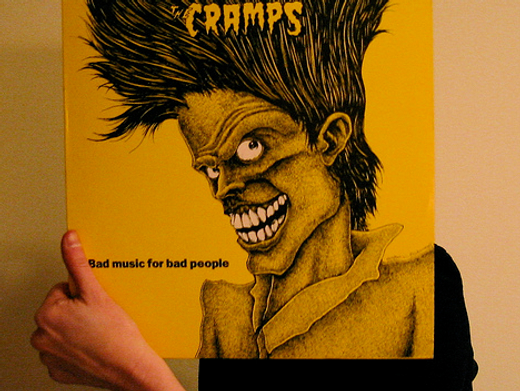
(Image from Sleeveface.com)
Clearly, cleaving between engineering & production is so difficult because the two are entwined, each serving to support or spoil the other. Those krautrock classics by Neu, Kraftwerk, and Ashra inspire visions of a futurist technotopia so effortlessly because of their painstaking, state-of-the-art construction. Likewise, the Wu-Tang Clan's debut remains a touchstone of rough, streetwise hip-hop because it sounds rougher than a spiked bat.

Ah, but what's missing from the equation? The performance, the very thing being documented. A good performance is immediate & unmistakable; it almost requires concerted effort to record a strong performer so badly that no one would listen to it. The engineer's job is to prepare the physical environment & tools necessary to capture a good performance, whereas the producer's job is to enable a good performance. The producer is the architect of the soundworld in which the performer will be most at home. This may sounds nebulous & variegated, because it is, which is why no two producers work in precisely the same fashion. Many performers produce themselves, feeling (sometimes erroneously) that outside influence only interferes. Some producers are technical taskmasters, detail-oriented drill sergeants; others, like Rick Rubin, are closer to "life coaches," therapist-cum-sycophants who coax & cajole performers into their comfort zone. Arguably the most interesting are those producers who purposefully antagonize & nettle the performers, aware that certain artists thrive on adversity & discomfort.

So with everything that goes into a recording, it's galling that there are musicians who I don't feel have ever been produced perfectly. I don't necessarily mean "recorded badly" in that it sounds like a shit-caked dictaphone, but rather the artist was framed in a soundworld where they were not at home. As much as I adore Bowie's Berlin trilogy, those albums have always sounded a bit flat & musty, like old cardboard, as though the whole band was crammed into a single three-meter-wide, drywalled room. Station To Station is much more effectively layered in its arrangements, though musically it's nowhere near as coherent or compelling. I've also never been entirely satisfied with how The Fall or Sonic Youth have been recorded. They each came close to finding their pitch-perfect space for a single album in the '80s (The Wonderful and Frightening World and EVOL respectively), but sadly got lost again afterward. When they finally arrived (Fall Heads Roll and Washing Machine), their most striking innovations were long behind them.

At any rate, below is a mix of songs that, to me, strike the perfect balance between a strong performance and engineering that serves to create a distinctive, vivid soundworld.

Master Sculptors

1. Brian Eno - "Sky Saw"
2. Ashra - "77 Slightly Delayed"
3. D'Angelo - "Playa Playa"
4. Can - "Oh Yeah"
5. Wu-Tang Clan - "Bring Da Ruckus"
6. Nino Rota - "O Venezia, Venega, Venusia"
7. Bachi Da Pietra - "Altri Guasti"
8. The Jesus Lizard - "Seasick"
9. Scott Walker - "Clara"
10. My Bloody Valentine - "Come In Alone"

Wednesday, October 13, 2010

Bad Music, Worse Politics

They say "never judge a book by its cover," but what about judging a book by its pull-quotes and endorsements? A single-sentence excerpt from Meghan McCain's book is sufficient to see it's utter shite, and I certainly won't need to read anything that makes it onto either Oprah or Glenn Beck's book lists.

Musical taste can serve as a litmus test of someone's general character. This sounds like a dangerous and smug generalization, but think of it - have you ever met someone who preferred Yoko Ono to the Beatles who wasn't an insufferable prick? Similarly, is it ever a surprise when a hidebound fan of only hardcore punk or heavy metal turns out to be a socially-conservative reactionary? Music is not some autonomous miracle that happens by fluke. Music is dependent on context for meaning and is the direct product of human intervention - even if that intervention is the simple act of listening. (This is how John Cage could find musicality in the traditionally "non-musical.") To both the composer and the audience, music is never politically neutral.

This is why I'm such a staunch defender of indie dogmatists like Steve Albini, and why I'm very skeptical of populism, both musical and political: it discourages radicalism, sanctions tyranny of the majority, and buttresses the status quo. Unhesitant endorsement of pop music applauds the commodification of art and abets the homogenization of culture by consumerist capitalism. The gluttony of the indiscriminate listener enhances the neo-liberal fantasy of infinite abundance. Several years ago, Rob Horning outlined the fundamental danger of then-ascendant "poptimism":
It doesn’t really matter who likes what specifically; what matters are the means by which the big players seek to control the entertainment market... In capitalist society, culture is business, one that’s always trying to expand. Nice of the poptopian to do the marketers work for them and expand the reach and provide the ideological justification for the hegemony of the big commercial music manufacturers.
So much of the vitriol aimed at Albini over the past week has little to do with the substance of his argument and more to do with him "being a jerk." This would suggest that, instead of disagreeing with Albini, many people are merely upset that he's infringing on their guilt-free enjoyment of consumer culture. Tom Ewing (author of, appropriately, Pitchfork's Poptimist column) parodies Albini's contempt for the fashion industry by suggesting what Albini's rendering of soccer might look like:
“It’s just 22 men chasing a leather ball around!”
Reductive and contemptuous, perhaps, but also 100% accurate. Again, the implication is that the exploitation of an insecure public and the predation upon art by capital is not nearly as offensive as being a buzzkill asshole. What matters not is critiquing and defending against market forces; what matters is letting everyone be into what they're into and, y'know, having fun!

Let me be clear, there are larger real-world consequences to poptimism's timid egalitarianism. Mike Barthel was among the many who, without challenging Albini's position, dismissed the attacks upon fashion and Sonic Youth's Faustian bargain as "stupid shit." Less than a week later, Barthel posted an op-ed at The Awl about Glenn Beck's autodidact schtick:
In terms of motivation, liberals' demands that the unpleasant parts of American history be taught in schools is no different from conservatives' insistence that they be expunged: both want the story told as they see it so that children will grow up sympathetic to their view of the world. Of course, liberals have the advantage in this case of wanting things to be revealing, rather than concealing. But that doesn't make our intentions any nobler, particularly.
And voila, in one simple extension of political logic, it's no more noble to fight for truth & accountability than it is to whitewash history in the name of imperialist nationalism. Because apparently it's better to tolerate jingoism and ignorance than to be an asshole and call people out on those things.

Whatever happened to "keeping keen the blade of one's dissatisfaction"?

Thursday, October 07, 2010

In the Logic of the Market, the Market Is Always Right

Providing context for the Albini/Sonic Youth controversy, Eric Harvey has a very interesting history of Sonic Youth's business dealings with labels minor and major. Most valuable is the reminder that, as businesses in the '80s, indie labels were hardly a utopian refuge from blood-sucking behemoth corporate culture. For sure, Dischord and Touch & Go were famously equitable with their artists while totally disavowing commercial ambition, but they were - and remain - the exception. Meanwhile, I've yet to find anyone that has a kind word to say about the likes of SST's Greg Ginn or Homestead's Barry Tenenbaum. (British indie labels seem to have been less regularly corrupt.) As Harvey says, "Who wouldn’t, in the early 90s, want to be able to make music for a living, with health care, while working right alongside one’s trustworthy indie pals?"

That said, I take serious issue with Harvey's argument once he moves beyond historical summary. First is his contention that "there’s an actual Main Stream into which bands are able to steer their ships" is an "ill-founded idea." In the age of the internet, that may be true: the only extant "underground" is just the shit people aren't listening to, as opposed to a separate, self-contained culture. But this is only true within the past decade. Does Harvey honestly believe that people going to Einstürzende Neubauten or Nation of Ulysses gigs and people buying Avalon or Achtung Baby were operating within the same social context?

The fundamental difference between Harvey and Albini is that the former believes the whole point of making music is to be heard by the widest audience possible. To wit:
Distribution and promotion is the key here. Indie labels used to suck at it, but in 2010, they’re really amazingly good at it, and they’re not shy about partnering with corporations like Warner to gain access to their monopoly on big box stores. And thankfully, it seems, the vast majority of indie fans... don’t care.
Anyone who praises "the usefulness of major corporations" sees music as little other than a commodity and is a foot soldier for cultural homogeneity. Albini, on the other hand, views music as a communicative mode, an expression of a localized cultural identity, a sonic individuation. What bothers Albini about corporate encroachment is not merely the crass desperation & hucksterism of marketing & promotion, but how it corrupts the very creative process. As he explained in a superb interview with Ian Svenonius:
Whenever [bands] start making decisions based on their anticipation of the future response from the outside world, then they're talking out their ass and they're making decisions based on a fear of a future reprisal or something...

A lot of the music industry sees the record as the object, like the record is the thing. And if you have to fuck with the band a little bit to make the record good, that's okay, 'cuz that's what we're selling... But if you compromise the band for the sake of the shows, or the sake of the records, then you're fucking with the business. That's the franchise right there.
This returns us to Albini's very purposeful separation between his work (engineering) and his art. As everyone knows, Albini is rather mercenary in who he'll record: anyone. But Shellac is infuriatingly uncompromising as a group of artists. They refuse the record-release-tour-repeat hamster wheel, turn down more shows than they play, and rigorously limit their public exposure. To someone like Harvey, whose musical philosophy is a synthesis of populism & capitalism, of course Albini comes off as provincial and exclusive. It simply means that he and Harvey have essentially different understandings of music's purpose.

But personally, I think Albini is right and Harvey is wrong. The very benefit Sonic Youth won with their major label deal - "We’re able to work 24 hours a day at making music" - is impossible in the internet-oriented music industry, because it forces bands to operate first & foremost as a business concern with the music itself reduced to mere product. The ultimate evil of disintegrating the divide between underground & mainstream culture is that D.I.Y. becomes unworkable and collusion with corporate interests is forced. When any band with a Bandcamp page can reasonably entertain dreams of making fat mad stacks of a Honda TV ad license, musicians are attempting to realize Bowie-sized commercial ambitions on a Black Flag-sized budget. In the old-school punk paradigm, being in complete control of production/distribution/promotion, while not easy, was more manageable because winning over the world was not the point. No one was hoping to headline Madison Square Gardens. But now, every band hanging onto the long tail is baited by the corrupt conflation of making music with making a living. Ultimately, both these musicians and the music itself will suffer.

Wednesday, October 06, 2010

A Messenger Who Shoots Back

One of the most oft-quoted lines from The Big Lebowski is The Dude's last-ditch retort to Walter: "You're not wrong, Walter, you're just an asshole." Lord knows I've been slapped with that rejoinder many a time. Just this weekend, a friend and I were arguing, basically, over whether or not such a thing as "black music" exists, and he said, "Look, I know what you're saying, and I can't quite disagree with it, but goddamn I want to punch you in the fucking face!"

But I digress. What's really fascinating about The Dude's retort is how dramatically its sense is changed by reversing the sentence structure: "You're an asshole, but you're not wrong." It's no longer a statement of bare tolerance of some dunderhead's invective; it's grudging acquiescence to the fact that someone thoroughly unlikeable has made an incontestable argument. It's a less-condescending version of the old "broken clock" saw, and - to me - not a bad rhetorical position to be in at all.

Steve Albini is a man whose whole public persona hinges on being this asshole-who's-not-wrong. He's clearly unconcerned with whether or not people "like" him, though he's rarely been prone to the kind of cartoonish abuse Tesco Vee used to heap upon the world at large. So it should come as no surprise that I woke up today to find see the following headlines around the interwebs:
Etc. etc. etc. It's not that Albini thinks Sonic Youth are a shitty band or a bunch of poseurs. ("I still consider them friends and their music has its own integrity.") Rather, Albini thinks that, by signing with a major label, Sonic Youth "became a foot soldier for [mainstream] culture's encroachment into my neck of the woods by acting as scouts." Sonic Youth lowered the drawbridge for the commercial huns and led to "a corruption of a perfectly valid, well-oiled music scene."

There's already been some considerable discussion here about Sonic Youth's "curatorial" stance, and ultimately I think they played that role well. Other bands who crossed over (e.g. Nirvana) made token gestures towards their underground peers by wearing T-shirts or name-dropping in interviews, but few were as urgent in championing music's margins as Sonic Youth. Had they not signed to Geffen, some other band would've torn a wormhole between the under- and above-ground; the commercial incursion into indie music would happen sooner or later. I think Sonic Youth understood this and worked to foster a more faithful relationship between the audience and underground music, a relationship that could've easily been superficial, fickle, and fleeting. As I wrote before:
The problem, then, is not of revolutionary intent or lack thereof, but of what if the revolution succeeds? As pure as it may be then to wipe one's hands, declare the job done, and ride off into the sunset, this leaves the freshly razed ground at the mercy of tyrants & thugs - be it Stalin or the Universal Music Group. Not to forfeit what was fought for requires the victors to become stewards of the movement - in artistic terms, curators. Though this role is frequently disdained for plasticising new forms and jealously protecting legacies, good curators use their seniority to support & shepherd younger artists flush with potential. Even if popular taste swings away, a safe haven for bold thinkers & iconoclasts will have been carved out, with nothing ceded for the sake of fame or money.
Where I think Albini is absolutely right in his criticism is that Sonic Youth "[took] a lot of people who didn't have aspirations or ambitions and encouraged them to be part of the mainstream music industry." In the sleeve photos for Goo (SY's first album for Geffen) and the video for "Kool Thing", the band adopted the glam-trash strut and Ray Ban-shaded thousand-yard stare of marquee-topping Rock Stars. It was clearly an ironic goof, laughing at the hilarity that a band once described as "pigfucker rock" were being ushered into the megawatt glare of mainstream success. But Albini identified the dangerous ambiguity of this stance in an interview last year:
If you see it as somewhat of an irony that someone from your background would be in the mainstream, you’re more inclined to participate in it. My experience has been that the more comfortable that outsiders get saying and doing stupid shit, the more the ironic distance narrows. And the ironic distance eventually narrows to a point of nothing. Then you have this sort of ascendancy where something from the underground, by ironically adopting the mannerisms of the mainstream, becomes the mainstream.

And there’s an ironic defense that people use who want to maintain some perspective on themselves of being outside of mainstream culture that allows them to do crass, gross, grasping things with the idea that “it’s O.K. because it’s me doing it because I’m doing it for all the right reasons. I’m doing it for our team” as it were. That’s the point when the ironic distance narrows and the person becomes the thing he was previously a parody of.
The immediate rebuttal that pretty much everyone has slung at Albini is that he engineered some of "alternative" rock's major-backed breakthrough albums, both good (PJ Harvey's Rid of Me) and bad (Bush's Razorblade Suitcase). Pitchfork writer Ryan Dombal snickers, "Perhaps he never cashed those checks?" But this cuts right to the heart of why Albini qualifies himself as an engineer, not a producer. Whereas a producer coaxes & sculpt the music to elicit a desired emotional response, an engineer must simply document a band with maximum fidelity. Any engineer worth their fee will have a workmanlike, time-to-make-the-donuts approach, because they are a technician, not an artist. Whether or not the band is any good (let alone "cool") is not Albini's problem. He isn't there to fuss over lyrics, make the chorus "pop", or tighten the drummer up with Beat Detective; he's there to capture a band's performance as transparently & truthfully as possible. If the chorus ain't catchy, if the tempo wobbles a few b.p.m., if the guitarist's tone is like an electric baloney sandwich pumped through a 10" thrift-store Squire amp, that's on the band, not Albini.

Monday, July 26, 2010

Lonely From the Heat

Like the rest of the whole damned planet, Japan is sweltering. For two weeks, the temperature has refused to dip below the thirties (the mid-eighties for you Yanks). Worse, the baking pavement of Tokyo creates a pocket of hot air that shoves aside any storm clouds that would bring relief from this sick, dense murk that squeezes like you were a sodden dish-sponge.

Not that this was unforseen, of course. I, for one, have been stepping outside only at night. But I'm not exactly a jolly-hockeysticks day-person anyway; I spend most of my time in dimly-lit rooms with chain-smoking cynics & embittered creative types (if with anyone). So really, I haven't had to re-tailor my routine at all.

Still, when hiding inside is less a preference than a matter of self-preservation, it's damned hard not to feel some pang of isolation & paranoia. Especially when the curtains are drawn all day. (A cardboard box is better insulated than the typical Japanese apartment, so any measures to repel sunlight are necessary.) I work from home, so unless I run by the grocery store to pick up more yogurt, I can easily pass an entire day without uttering a word - which is when strange things start ringing in my ears. Conversation is breathing room, both literal & psychological, allowing various threads to untangle in one's head. In silent isolation, it doesn't take long for those threads to fray or tangle into dense & troublesome knots.

Not terribly surprising, then, that so much of my current listening material sounds stir-crazy & paranoid. Not only are the songs often sung from fiercely antisocial points-of-view, but the production itself sketches in bold the outline of the very room in which the music was recorded. When music is heard as from within its own space, it's not escapist, not an invitation to some ethereal/immaterial non-space: it's a retreat, a withdrawal to that finite space in which you're trapped simply by listening.

So I'm exorcising my stereo of claustrophobia and passing it on to yours, given that you're probably reading this in air-conditioned confines outside which heat haze is heaving off the concrete. Click on the mix title to download.

What Comes Into My Yard Is Mine

1. Shellac - "Didn't We Deserve a Look At the Way You Really Are"
2. Nick Cave & the Bad Seeds - "Cabin Fever!"
3. Lungfish - "Oppress Yourself"
4. Sonic Youth - "Shadow of a Doubt"
5. Ennio Morricone - "Grotesque Suspense"
6. Glenn Branca - Symphony No. 6, Fourth Movement
7. The Fall - "Neighbourhood of Infinity"
8. This Heat - "Twilight Furniture"
9. Fugazi - "Stacks"
10. Ben Frost - "Through the Glass of the Roof"
11. Swans - "A Screw" (Live)
12. Z - "500万円"