Showing posts with label Physicality. Show all posts

Tuesday, February 21, 2012

Objects Collecting Subjects

Over ye Impostume way, Carl poses a small, concrete question which very quickly balloons into a mammoth, existential one. At the outset, I thought we were basically talking about storage media and instead we may as well be asking ourselves, why listen to music? Or even more broadly, why art?

Those questions are impossible to answer, so Carl does us the service of scaling it down:
...what is the impulse to keep hold of all that non-essential stuff, stuff you are not invested enough in to listen to more than once, yet alone pay for?
Which is still a damned difficult question, if only because I've no idea by what standard we're measuring - how much stuff? Is it non-essential by my own standards, or society's? What about the stuff we have paid for? To understand my trouble in establishing a workable baseline, let's take a look at some of my closest friends and their respective music-consumption habits.
  • One is an amateur noise-maker with a steadfast belief in the shamanic power of music - yet, as a digital Maoist, he listens to music primarily via YouTube. He occasionally buys vinyl records, but he doesn't own a turntable. (The son of an investment banker, he treats records much as speculators treat real estate.)
  • Another is a collector par excellence, who's plowed unfathomable amounts of time & money into every passing storage medium - yes, even MiniDisc - on the off-chance that this format will become the historical default. Consequent to his unyielding compulsion for accumulation, he possesses both an embarrassing assortment of obsolete petroleum-derived media and an unimpeachable record collection.
  • My band's drummer spends his waking life behind either the kit or the wheel. In Japan, every car still comes stocked with yer standard CD player, thus he listens almost exclusively to CDs.
  • Our singer approximates what I imagine is today's average music consumer: functionally computer-literate, he knows a couple of file-sharing sites that he infrequently downloads illicit MP3s from, but he relies by-and-large upon the iTunes store. He came of age during the CD boom, purchased hundreds of the damned things, and is thus uncomfortable with either going digital - divesting himself of physical musical objects - or fully embracing the frail, impermanent, totemic atavism of vinyl.
Of the above, I most closely resemble the collector, but with two heavy caveats: that I could never match his mania, and that I discard or neglect a far greater swath of music. If I may call myself, like him, a collector, I certainly can't call myself an archivist. I don't accumulate for posterity: sure, I love Ghostface, but I'm not going to buy The Pretty Toney Album just to complete the discography.

I'm actually quite vicious in my musical discrimination, to the point that I'm one of those so-called "music nerds" who is somehow ignorant of even the most popular music on the planet. (Lady Gaga? Still haven't heard a full song start-to-finish.) By now, I know my own tastes well enough to know when something isn't even worth investigating; or if an artist, though unimpressive at first, could become a slow-blooming favourite. Of course, over the past forty years, artists have become ever more self-aware and adept at deploying their particular potpourri of signifiers to establish themselves as more brand than band. The sole benefit of music's infection by the marketing brain parasite is that, simply by paying attention, one becomes well-versed in the signs, symbols, satorial choices, tonsorial maneuvers, promotional stratagems, and subcultural propaganda necessary to decide if something may be worth a listen.

The upshot is that the more I know about music, the less I listen to (a paradox I've addressed before). By the time I download a given album, I've pretty well decided that I'll enjoy it - all that remains is the question of how much. This could point to a key difference between me and Carl: whereas he's fairly certain he "could happily live without 80 percent of what I have downloaded over the years," I'm not so sure I could, because everything on my hard drive arrived there as the result of research & deliberation. There's only so much copper in the ground, there's only so much storage on my computer, and I've only so much time to waste upon whimsy & poor consideration.

But even then, is all my digital music essential? Because I own almost all of it on vinyl too. Granted, the acrimony of the collector's market has kept certain albums off my shelf (I'll be damned if I can afford a copy of Rid of Me) but such exceptions are relatively few. Just about every album that's ever "meant" anything to me, I have in physical format - which helps assure that these albums will continue to mean something to me.

Though this carries the stink of the Sunk Cost Fallacy, of course I don't mean my copy of Man Overboard is merely worth the hours spent crate-digging before plucking it out of a bargain bin, plus the ¥500 I paid for it. Records imbue the music they contain with import precisely because of the format's Achilles' heel: its physical fragility. Taking proper care of vinyl can be boring and expensive; handling & playing them so as not to do damage is precarious and prudish. So if I go to the trouble of putting a record on, I damn well want to listen to it, and the act of listening itself becomes center of my attention. The palaver of playing a record also insures that it's unlikely I'll overplay any given album and prostitute whatever mystique it once held.

Music is literally nothing if we don't afford it our time and attention; the ritual around playing a record is a gesture of respect to the music - the sacrifice of our time and attention.

The difficulty is that collecting always takes place in the shadow of the Big Other. At worst, this leads to the establishment-of-self-via-consumption that Carl finds troubling:
...the weight of all that accumulated culture reassures us that we are ourselves substantial, a kind of prosthesis, we must be smart, we must be committed, we must be artistic, or intellectual because the sheer range and diversity of our hard drive, as a kind of concretization of our restless seeking and searching memorializes us to ourselves.
Now, as I explained above, I've no idea how far out of step I am with the general music listening populace, but as a collector I too consider how my collection presents itself - its depth, its diversity, its material condition. But I'm not counting on my collection to buttress my reputation or enhance my cachet: I'm counting on the fact that these records are the only possible means of sharing my own aesthetic epiphanies with another person. I'm well aware of how counterproductive a distraction analog fetishism can be, but at least the lingering spectre of a record's totemic power is far more commanding of attention than an MP3 e-mail attachment or YouTube link.

More importantly, we human are subjects only to ourselves and mere objects to everyone else - noisy, unpredictable, combatative, delightful objects, but objects nonetheless. Some of us are gifted enough to translate our feelings somewhat effectively to other people by some form of vibration: physical, aural, oral, or corporeal. But most of us aren't. Most of us are bloody useless at making ourselves understood. The best hope we have is to find meaning inscribed upon some other, nonhuman object that we can pass to another human, who luckily will read the inscription with the same surprise and passion that we did.

Saturday, December 04, 2010

Invasion and Occupation of the Ears

As I explained in my last post, the late fall frequently finds me seeking a little distance from the outside world. While this is usually accomplished by adopting a new hobby or subcultural fascination, I just as often self-impose arbitrary & unrealistic deadlines for mammoth projects - as though Death's icy grip will close faster around my throat if I don't release two albums and a 7" by New Year's Eve. Perhaps I'm terrified of being without braggable exploits during the inevitable holiday reunions with old acquaintances. On the other hand, if I manage total consistency for another decade, what is underwhelming now will have become gloriously eccentric: an artsy polymath circa 30, without a stable income since his early twenties, is just some pseudo-bohemian loser - but when you're knocking on 40's door, dude, you're Daniel Higgs.

I digress. The point is that, several months ago, I sat down and assigned myself several large projects with little chance they'd all be completed by the late-December cutoff. What's amazing is that I might actually succeed.
  • After intermittent recording over the autumn, my band finally completed an album's worth of demos, from which we selected a well-matched pair of songs for a quick 'n' gritty 7" single; I placed the order with the pressing plant yesterday, in time to get the test pressings back before Christmas.
  • What started as a sonic sketchbook of improvised production exercises somehow coalesced into an album. I should have it pressed up in time for a run of shows coming next week, though I'm not sure if a bunch of post-hardcore kids & aging alts will be very interested in my bogus Frippery. Maybe Kranky will release it and I can start doing improv gigs with Fennesz.
  • Meanwhile, I overstepped my musical bounds by several strides and decided to *ahem* make beats. This was largely out of frustration with the likes of Doom, Madlib, and Oh No, whose releases are maddeningly half-brilliant, half-baked. Instead of groaning when a banger like "Gazillion Ear" is followed up by filler like "Ballskin", why not just stitch together a solid 30 minutes of samples that I already like?
Only that last project is unlikely to see light before year's end, but at least sample-splicing and beat-tweaking will keep me busy during the dull moments of the holiday season.

Consequently, my ears have been worked into callused stumps. Demo recording was especially exciting and excrutiating: what could've been a no-frills rehearsal recording ballooned into a kitchen-sink production exercise. I suspect this was because our bassist (the veteran of the band) was "auditioning" me to engineer our album when we record in earnest next year; more likely, though, no one had a clue what "our sound" is. ("This song is kinda PiL-ish, but that song should sound like a track from Goo.") To accomodate diverse stylistic demands, from song to song I aped different engineer's signature styles - some Alan Moulder here, a dash of Andy Johns there, and more than a little Steve Albini throughout. This was made difficult by a paltry selection of microphones and a limited number of inputs. Alone, either one of these doesn't hopelessly hamstring a recording. After all, The Beatles & George Martin were able to craft Sgt. Pepper's on four tracks - but they had several-thousand-dollar microphones and outboard gear almost worth killing for. Conversely, Slayer's epic Reign In Blood was recorded almost entirely with cheap, small-diaphragm dynamic mics - but with 24 tracks all blazing at once. I, on the other hand, was trying to siphon torrents of sound through a bunch of Beta-57s into 8 tracks - not quite as difficult as trying to part the Red Sea with a teaspoon & a paper fan, but almost.

Excuses aside, everyone was (mercifully) pleased with the results.

As maddening as handicapped recording sessions can be, they stage incredible games of mental chess. Technical limitations force ingenuity, while inspiring "what if?" scenarios for the next step. For example, now that I've managed to achieve a decent three-mic drum sound, will I record the drums differently when I have 16 simultaneous inputs available? Would an ORTF stereo pair or an M-S setup sound better in this room? Why not run the bass through a Marshall and the guitar through an Ampeg?

The process provoked me to revisit my old recording textbooks, not to mention it's given me renewed concentration as a music listener. Studying every whisper & crash that comes out of my speakers has reminded me of the oft-forgotten distinction between engineering and production: engineering is material, the nuts-'n'-bolts mechanical documentation of a sound, whereas production is metaphysical, the sculpture of music's intangible qualities. The two are commonly confused, if only because it's tempting to assign why music moves us emotionally to its material qualities.

Take Steely Dan, a band renowned for their meticulously-constructed records which sound as clear & smooth as a fine Scotch. I've always found them too clinical, distant, dull. Presumably, Becker & Fagen don't mean their music to have all the vitality of a dead sturgeon, so as productions, are they failures?

Meanwhile, there's plenty of deliberately ugly music out there - from black metal's treble-heavy buzz to the speaker-exploding grit of Brainbombs or the Psychic Paramount. While such records are ostensibly examples of "bad recording," it's obvious that these acts want to sound repellent, and their audial odiousness is the very reason why some listeners love them and others loathe them. Thus, as productions, does such music succeed even when repulsing a portion of its audience?

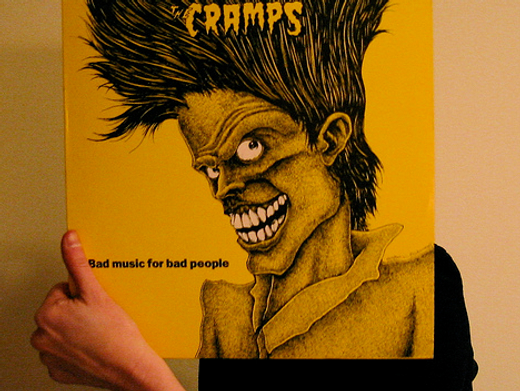
(Image from Sleeveface.com)
Clearly, cleaving between engineering & production is so difficult because the two are entwined, each serving to support or spoil the other. Those krautrock classics by Neu, Kraftwerk, and Ashra inspire visions of a futurist technotopia so effortlessly because of their painstaking, state-of-the-art construction. Likewise, the Wu-Tang Clan's debut remains a touchstone of rough, streetwise hip-hop because it sounds rougher than a spiked bat.

Ah, but what's missing from the equation? The performance, the very thing being documented. A good performance is immediate & unmistakable; it almost requires concerted effort to record a strong performer so badly that no one would listen to it. The engineer's job is to prepare the physical environment & tools necessary to capture a good performance, whereas the producer's job is to enable a good performance. The producer is the architect of the soundworld in which the performer will be most at home. This may sounds nebulous & variegated, because it is, which is why no two producers work in precisely the same fashion. Many performers produce themselves, feeling (sometimes erroneously) that outside influence only interferes. Some producers are technical taskmasters, detail-oriented drill sergeants; others, like Rick Rubin, are closer to "life coaches," therapist-cum-sycophants who coax & cajole performers into their comfort zone. Arguably the most interesting are those producers who purposefully antagonize & nettle the performers, aware that certain artists thrive on adversity & discomfort.

So with everything that goes into a recording, it's galling that there are musicians who I don't feel have ever been produced perfectly. I don't necessarily mean "recorded badly" in that it sounds like a shit-caked dictaphone, but rather the artist was framed in a soundworld where they were not at home. As much as I adore Bowie's Berlin trilogy, those albums have always sounded a bit flat & musty, like old cardboard, as though the whole band was crammed into a single three-meter-wide, drywalled room. Station To Station is much more effectively layered in its arrangements, though musically it's nowhere near as coherent or compelling. I've also never been entirely satisfied with how The Fall or Sonic Youth have been recorded. They each came close to finding their pitch-perfect space for a single album in the '80s (The Wonderful and Frightening World and EVOL respectively), but sadly got lost again afterward. When they finally arrived (Fall Heads Roll and Washing Machine), their most striking innovations were long behind them.

At any rate, below is a mix of songs that, to me, strike the perfect balance between a strong performance and engineering that serves to create a distinctive, vivid soundworld.

Master Sculptors

1. Brian Eno - "Sky Saw"
2. Ashra - "77 Slightly Delayed"
3. D'Angelo - "Playa Playa"
4. Can - "Oh Yeah"
5. Wu-Tang Clan - "Bring Da Ruckus"
6. Nino Rota - "O Venezia, Venega, Venusia"
7. Bachi Da Pietra - "Altri Guasti"
8. The Jesus Lizard - "Seasick"
9. Scott Walker - "Clara"
10. My Bloody Valentine - "Come In Alone"

Sunday, September 26, 2010

Freaks and Fire in Japan's Second City

Funny how stereotypes can be so stubbornly self-sustaining. A few years ago, I showed some friends in Baltimore my favourite Japanese TV show, Gaki No Tsukai. Though most found it hysterical (if mildly disturbing), one friend was actually angry with me. "Y'know," she started, "whenever I say 'my friend lives in Japan,' I spend all this time telling people it's not like you live on Mars, it's not completely batshit insane, not a real-life Blade Runner, the Japanese are just normal cats with some slightly different cultural conditioning - and then you show me this. What the hell am I supposed to think now?"

Similarly, six years ago, almost all I knew of Japan was the lunatic notoriety of the Osaka noise scene. Tokyo was forest of steel & neon, Kyoto was all bamboo & raked pebble gardens, and Osaka was an open-air asylum packed with certifiable nutters who'd swapped bushido for bulldozers & fuzzboxes. Of course, after moving here, I saw how coarse & ignorant this assessment was. Tokyo is an omnivorous hyperreality, Kyoto is more than a historical diorama, and any perceived derangement on the part of Osaka-jin was likely more middle-child contrarianism than a hysteria innate to the city.

But after last weekend's Bakuto festival, I take that last bit back. There really is something in the Kansai water, and Osaka people are off the fuckin' hook. Okay, that's a little unfair: any festival will draw a self-selecting (and thus unrepresentative) multitude. Bakuto is equal parts skate show, dub-head soundclash, tattoo convention, and experimental rock extravaganza - none of which screams "mainstream appeal." But if I threw a loudly-'n'-proudly "countercultural" festival in Tokyo, I'd likely draw as many reactionary nationalists ("Death to post-modern demographics!") as anyone. I certainly couldn't expect the diverse congregation of J-dreads, mori gyaru, baggie skaters, gangsta pseuds, techno-hippies, hardcore punks, fashionistas, greasers, tweakers, pushers, enforcers, Vice mag devotees, expat Williamsburg/Brighton wannabes, aloof chin-strokers, awkward tag-alongs, and unhinged musos that populated Bakuto.

Immediately striking is the festival's setting: a disused shipyard, backdropped by the post-industrial rust & grime of the Suminoeku waterfront. Strolling the docks, it's hard to see whether or not the outside world has indeed crumbled into the yawn of the apocalypse. This dilapidation at once encourages avant-gardistes to bring their convention-smashing A-game, yet makes whatever Neubauten-esque mayhem ensues seem merely appropriate to the environs.

My band was playing the outside stage (next to the skate park) in the mid-afternoon. I spent most of the morning people-watching and wandering wantonly. The earliest bands were all the kind of willfully-amateur, pseudo-tribal dance-punk acts that made Wham City famous, despite how dull & gimmicky they are. Watching a band with the exquisitely dull & gimmicky name Ultrafuckers (ウルトラファッカーズ), a Jared Swilley lookalike was trying way too hard to be really into it while simultaneously stonewalling me, as I depressed his currency as "in-the-know" white guy. Tokenism will only get you laid for so long, dude.

Lunch was a Kafkaesque experience that bordered on sensory breakdown - which had nothing to do with the quality of food. I'd slunk indoors to avoid sunstroke, but the second-floor concourse was sandwiched between competing bass frequencies of obscene volume. From above came the indolent throb of house DJs soundtracking the tattoo convention, while below bands on the Gareki stage vied for sonic supremacy with the incessant thrum of the "Black Chamber" drum-n-bass room. The whole building - windows, walls, ventilation ducts - groaned as several streams of sub swam in and out of phase, coalescing into the same ear-canal-clenching whomp as the Inception score. It sounded... no, it felt like a war zone. Seasick and half-deaf, I stumbled back outside.

Happily, Bakuto delivered that epiphany you always hope for at festivals: when you discover the kind of music you knew someone had to be making but had yet to hear. Kyojin Yueni Dekai (巨人ゆえにデカイ) more-or-less translates as "Because I'm a Giant, I'm Big," which explains why frontman Mizuuchi Yoshihito plays atop stilts, exaggerating his already wiry & mantis-like frame. His guitar has the tinny, equivocal tone of a shamisen or wounded banjo, except for the bass string substituted in the instrument's lower register. The bass string is so roughly detuned that it doesn't so much articulate notes as belch concussively; an atonal gut-punch. Skinsman Wada Shinji alternates between the most minimal of percussive accents and blastbeat freakouts, mirroring Mizuuchi's vocals as he leaps from stony blankness to hoarse bellow. But catharsis is always deferred in favour of suffering the anticipation of the next note; restraint and painfully drawn-out pauses become more tensely theatrical than any punk shitfit abreaction. The effect is like mid-'80s Swans if Gira had been a kabuki student instead of a construction worker.

Unfortunately, two acts that I was especially looking forward to - オシリペンペンズ and オニジャガデルカ - were both playing at the same time as my band. Still, we had a healthy turnout considering we were competing for attention with two giants of the Osaka underground. Hell, I wouldn't even blame someone for skipping our set to go watch the Battle Robots.* Don't get me wrong, I think we're pretty good, but not a lot can compete with remote-controlled scrap-heaps going at it hammer-and-tongs-and-flamethrower.

Some acts were less willing to sacrifice their audience share to automated warriors, and fought fire with fire - literally. Following our set was D.D.S., who performed as a kind of checklist for "subversive" noise rock. Bondage masks? Check. Samples of Hitler? Check. Theremin, circuit bending, turntable abuse? Yep. Gratuitous immolation of old televisions? Of course - but these brainiacs had set the TVs atop a stack of old tires. They deliberately started a tire fire. As plumes of noxious yellow smoke rose into the sky, an ambulance came screaming onto the festival grounds. I suppose the authorities reasonably assumed the sudden expulsion of fumes meant some bad shit was going down.

D.D.S.'s vocalist responded to this incursion by clambering atop the fence and hollering at the EMTs, "Dees eez LOCK AND LOLL!" Couldn't really argue with that, eh?

(*) - That's actually my band in the background of this video clip.

Thursday, June 17, 2010

For Fans of La Furia Roja

Not that I had a horse in this race, but...


A word of advice to Spain: possession might be nine-tenths of the law, but the last tenth is doing something with it.