So Whitney Houston dies and suddenly everyone gives a shit about the foghorn-voiced cokehead who gifted us with the only vocal performance more oppressive than Celine Dion's Titanic theme. How sadly predictable; how pathetically mawkish. Why does everyone rush to recall their Edenic first impression of a once-formidable talent once that person has crashed, burned, and kicked the bucket? Is it the public's way of absolving their own guilt for having used the fallen celebrity as a feeble punchline for the final decade-plus of their life? Despite the fact that some of us had problems - both aesthetic and political - with the woman from the very start?
Please. I really like some of Michael Jackson's records and I still didn't give a shit when he died, for reasons I'll let Kat Williams elaborate upon. Oh, and dig the bonus swipe at the cadaver du jour.
Sweet merciful crap, a man whose net worth is between $190-250 million said he doesn't care about poor people? And people are shocked & appalled? My god, we should be applauding the man for his honesty! About fucking time someone came out and said it.
The law, the public authority: is it not established to protect weakness against injustice and oppression? It is thus an offense to all social principles to place it entirely in the hands of the rich.
But the rich, the powerful, have reasoned differently. Through a strange abuse of words, they have restricted the general idea of property to certain objects only; they have called only themselves property owners; they have claimed that only property owners were worthy of the name of citizen; they have named their own particular interest the general interest, and to ensure the success of that claim, they have seized all social power. And we! oh human weakness! we who aspire to bring them back to the principles of equality and justice, it is still on the basis of these absurd and cruel prejudices that we are seeking, without being aware of it, to raise our constitution!
...what is the source of that extreme inequality of fortunes that concentrates all the wealth in a small number of hands? Does it now lie in bad laws, bad governments, and finally all the faults of corrupt societies? ...I envy not at all the advantageous share you have received, since this inequality is a necessary or incurable evil: but at least, do not take from me the imprescriptable property of which no human law can strip me. Indeed, allow me to be proud sometimes of an honourable poverty, and do not seek to humiliate me with the vainglorious pretension that the quality of sovereign is reserved for you, while I am left with only that of subject.
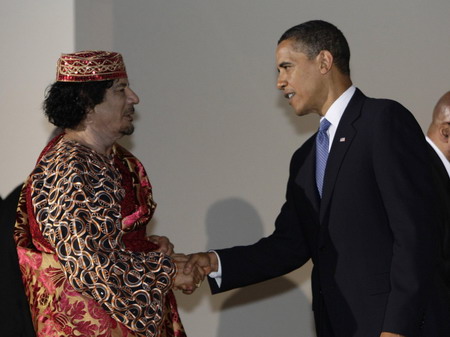
Death, it's been noted, is no surprise. And on a planet packed with 123 people per square mile, the numbers dropping by the day are dizzying. Still, it feels like I wake every other day to find some globally-important figure has slipped - or been shoved off - this mortal coil. A Saudi prince here, an asshole billionaire there. But I was thoroughly unprepared to begin Friday being gawked at by Qaddafi's droopy kabuki corpse-maw. Put me right off the strawberry yogurt I was eating for breakfast.
Surveying the online reaction, I was pleased to see the relative restraint across social media, as braying gaiety over Qaddafi's death was kept to a minimum. Given that Qaddafi was directly, provably responsible for more deaths & acts of international terrorism (cf. the Abu Salim massacre, Pan Am flights 103 and 73, UTA Flight 772, the 1986 La Belle bombing) than Osama Bin Laden was, I'd like to think that everyone had sobered up since the bloodlusty celebrations of Bin Laden's murder. Oh, I'd like to think that, but let's not be naïve - fewer people remember, and fewer still care, about Qaddafi's towering bodycount.
What jubilant chest-thumping there was came overwhelmingly from the liberal media - that is, the meager 10% of the media that actually is liberal. Most visibly, Keith Olbermann and Jon Stewart attacked Republicans for refusing President Obama any credit for Qaddafi's demise. Of course, Olbermann & Stewart are correct that when, for example, Marco Rubio applauds the British & French for leading the charge into Libya, the GOP are playing politics by cynical omission, rather than giving credit where it is, in fact, due. But for men who built careers lambasting the illegal brutality of the last administration, Olbermann & Stewart - not to mention their acolytes - are unnervingly comfortable with the fact that their Nobel Laureate President's greatest legacy may very well be, in Stewart's own words, "his ability to rain targeted death from the sky." I can only imagine the righteous tongue-lashing Olbermann & Stewart would have given Bush when he signed Executive Order 13477, which restored the Libyan government's immunity from pending & future terrorism-related lawsuits. But in the mafioso logic of American exceptionalism, there's always room for another murder, as long as our guy is pulling the trigger.
It's this smug, fickle partisanship that makes our elected leaders so depressingly fungible. Meet the new boss...
The overwrought pageantry that passes for political punditry is so hackneyed & calculated, it's a wonder anyone pretends to be surprised anymore. Everyone so desperately admires & awaits a Howard Beale or Barry Champlain moment, forgetting (or ignoring) how expertly stage-managed & corralled by corporate interests those fictional "mavericks" were. Thus audience & broadcaster alike have managed to turn yet another non-event - Glenn Beck's exit from the Fox News network - into frothing political scopophilia.
Personally, I could give a fuck, not the least because I live outside America and have no TV or radio. More importantly, Beck himself is not special: his is a role to be filled by whatever appropriately attention-hungry ex-cokehead lunges hardest towards the microphone. But, as I explained last month in an e-mail to a friend, I'd had an appalling premonition about Beck's next step:
Beck can get the fuck off the air already. The only thing I'm worried about now is that, for his next act, he'll undergo some histrionic "crisis of faith" in the conservative movement and refashion himself into a pseudo-libertarian leftist and everyone will eat that shit right up. Don't think it can't happen! Ariana Huffington pulled off that stunt with startling efficacy (though I believe she's far more sincere than Beck has ever been).
But surely such a mawkish turn would be so transparent & tacky, no one would fall for it, right? I mean, come on. Yet, yet, yet, as I click across to Crooks & Liars this morning, what do I see atop the front page?
Well, stomp on frogs 'n' shove a crowbar up mah nose! Who'da fucking thunk it. As good forgive-and-forget liberals, we should presently, if prudently, embrace the Fox News rodeo clown, not only for his dubious disillusionment with both mainstream political parties, but because Beck is (now) solidly against extraordinary rendition:
"Ghost planes - we're picking people up in the middle of the night. We're saying talk to us or we're going to drop you off over in Egypt. That's insane... We don't stand for anything."
Beck is unconvinced of the efficacy of state-sponsored kidnapping & torture (for which legal repercussions have justbeen forever swept off the table). Welcome to the club, buddy! Everyone against zapping civilians' scrotii with car batteries gets a gold star! If you disapprove of kidnapping, you get a cookie! How about this: as long as we're doling out special credit for shit you're supposed to do, can I get extra sprinkles on my sundae given that I've resisted the temptation to chainsaw off my neighbour's head & fuck his wife?
As much as I've tried to mediate my media intake since Monday, the consensual tenor of American liberals has been unmistakable: unity! Now is not the time for partisan bickering, point-scoring, or revisionism. Now is the time for America to reclaim its sense of divine purpose, to see its pride bloom phoenix-like, and to (again) nail shut history's coffin! Everyone wave your copy of Team America: World Police in the air like you just don't care!
But chest-thumping machismo isn't a good look for liberals, nor one they're accustomed to, and so there's been the perfunctory lip-service to civil liberties, common dignity, and the rule of law. This in turn produces an aneurysm-inducing level of cognitive dissonance - hypocrisy & self-serving sanctimony so impenetrable that, for example, a single NYT editorial can proclaim that torture "violate[s] the law and any acceptable moral standard" while simultaneously asserting that "the battered intelligence community should now be basking in the glory of a successful operation."
After a decade of having been defamed as cowards, pinkos, pantywaists, apologists, and traitors, and especially now that their guy is in office, American liberals are desperate to occupy the first-person plural within "We killed Bin Laden!" Are they sure they want to put themselves at the center of the story? There is a way for liberals to indulge their id-inflamed glee while distancing themselves from the decade-long horror show preceding Bin Laden's demise. If instead of "we," they said that "a military-mafioso squad of anonymous assassins, operating outside international law, killed Bin Laden," then they'd be mere apologists (as opposed to patrons) of state-sponsored murder.
For once in my damn life, I appear to have nailed the zeitgeist: the "sell-out" debates of yore are back in full swing. And about a decade too late, if the current cultural climate is as sapped & shit-stained as it appears. Oh, and for all those poptimists who endorse crowdsourcing and believe equally in the integrity of democracy and market forces: welcome to your logical extreme! Choke on it, you beige-minded wretches.
I realize it may be gauche to repost something I myself wrote, but I feel like the point is valuable enough not to be left sulking at the ass-end of a comment thread...
I did read Abebe's piece on Pitchfork RE: the NYT/M.I.A. fracas, and it was indeed pretty good. Though the whole cloak metaphor was thoroughly ground into glue. And as much as I'd like "to not act like she's speaking for anything beyond her own messy self," such dubious hair-splitting lets people apologise for incredibly dangerous politics/artists/aesthetics. Let's replace "M.I.A." with "Burzum" and "militarized underclass" with "white-supremacist pagan theocracy" and see how quick people are to "swallow the music and spit out the cloak" - and whether or not embracing the medium while rejecting the message seems acceptable in the first place.
Besides, Maya Aruplragasam herself insists that her listeners don't make such distinctions. Pity for her fans that are busily crafting the narrative (as ventriloquised by Simon Reynolds):
"of course pop stars talk drivel about politics, of course they're all about empty gestures and sensationalism and pointless provocation. That's what makes it pop, what makes it good pop actually. It's pop music, what did you expect?"
Crooks & Liars asks what I've been wondering myself: why is Helen Thomas (who held G.W. Bush's feet to the fire more than any other White House press corps suck-up) ignominiously shoved onto an ice flow because people confused anti-Zionism with anti-Semitism, while bloody Ann Coulter & Glenn Beck are not only still on the air but are boosting books by Nazi sympathisers?
It's embarrassing to see aging rockstars prancing with all the libidinous abandon of teenagers - not the least because of how their jowls flap now that the elasticity has been sapped from their skin. There's something inappropriate in seeing arthritic ex-junkies singing songs like "(I Can't Get No) Satisfaction" and "The Kids Are Alright" when they should be at home watching The McLaughlin Group or Question Time, waiting for their next pension check and wondering why their kids haven't called in so long.
But as quickly as everyone groans at cankering Paul McCartney and the withered Bob Dylan, they not only tolerate but encourage the retrospective victory laps being run by "alternative"-era rock icons. No one was convinced that it was necessary, let alone cool, for the Eagles and Fleetwood Mac to reunite in the mid-'90s, but Generation-X and its successors have yet to show a shred of their characteristic disillusioned nonchalance towards the Pixies, Blur, Dinosaur Jr, Faith No More, the Jesus Lizard, the Jesus and Mary Chain, My Bloody Valentine, Sleep... uh, Polvo...
There are almost more '90s bands these days than there where in the '90s.
This gush of resurrection isn't as welcome with Mark "K-Punk" Fisher, who in the latest issue of Loops attempts to answer the question of why bands don't break up any more. It's a timely query, given that the Pavement reunion has nailed shut the coffin of baby-boomer cultural hegemony. The '90s are haunting the '10s, as they were haunted by the '70s, because - especially in the nanosecond hypecycle of the information age - it takes too much damned effort to remain au courant. No longer endowed with the impetuous energy & autonomy of twentysomethings, Generation-X have more pressing errands than surfing music blogs or attending Todd P shows and are probably content to dust off their 15-year-old Sub Pop & Matador records when they want to tickle their cochlea.
The second issue is the internet itself: a whole generation has by now grown up without the memory of mail-order or the Dewey Decimal System, with the wealth of all history a mere Google search away. "In the age of Web 2.0," writes Fisher, "nothing goes away, everything comes back – if not in the flesh, then as a YouTube clip." How could this produce anything but an infinite feedback loop? It's an odd nostalgic simulacrum - memory not necessarily anchored in experience - but it's a kind of nostalgia nonetheless.
This makes it easy to see why a band that broke up a decade ago would want to reform: in addition to their old fans, there's a whole new generation keen to see what they missed the first time around. Who'd prefer to watch grainy bootleg videos of My Bloody Valentine when you could see them in the flesh?
The other, more cynical answer is that contemporary music is such shit, bereft of imagination or vitality, that the shoes of the last batch of bands have yet to be filled. If the scariest & most dynamic experience to be had in the contemporary hardcore scene is Daughters covering the Jesus Lizard, then please, cut to the chase and get David Yow himself back onstage.
Fisher seems to reserve special disdain for the acts who, like the Stones and The Who, did not fade away: The Fall, Nick Cave, Sonic Youth, etc. As cynical and sticky-fingered as reunion tours can be, there aren't many people who'd opt not to pay off their mortgage playing in a rock band instead of punching the clock down at patent office or call center. This is easier to understand than the musicians who, through good fortune and/or force of will, never quit the stage. Carl made a similar complaint about "career artists" a while back, but that sounded more like a case of sour grapes than anything. For Mark Fisher, the persistence of formerly "underground" acts is a betrayal of their original raison d'être: "wasn't this everything that post punk's scorched-earth modernism disdained?"
Of course, if he more closely examined the acts he accuses of perfidy, he'd find no inconsistency. For example, The Fall's mayor domo, Mark E. Smith, has often been compared (by Fisher himself, too) to a factory foreman, a wizened prole whose devotion is solely to his work. Nevermind that it's silly to chastise a band, whose first single included the tune "Repetition", for their dogged persistence; Smith's no-nonsense work ethic and incessant (if inconsistent) productivity are directly at odds with rock's no-future hedonism and its planned-obsolescence capitalist ethos. Also, as the developed world has de-industrialised into an anaesthetised service-oriented pleasuredome, much of society's ills stem from the fact that we don't make anything any more. Amidst regurgitative mash-ups and laptop-toting "performers", a guitar act that pays the rent through gigging, instead of media saturation, is as much an anachronism as steel mills and and mines. This actually casts The Fall further from mainstream society than the band was at its inception in the late '70s.
Sonic Youth, meanwhile, are victims of their own success. It's not that the band ever disavowed itself of the revolutionary intent of the No Wave scene (though I imagine Fisher would be rather disappointed to know that most of its participants went on to join more historically reverent & formalist units like the Lounge Lizards). By the time SY's most startling innovations were behind them and they signed with a major label, the band wasn't selling out to the mainstream: they were the mainstream, godfathers to the entirety of '90s "alternative" culture. Their appearances on MTV and atop festival playbills weren't the product of some crafty publicist, but again of an intransigent work ethic and the crafting of an aural aesthetic that captured the popular imagination.
The problem, then, is not of revolutionary intent or lack thereof, but of what if the revolution succeeds? As pure as it may be then to wipe one's hands, declare the job done, and ride off into the sunset, this leaves the freshly razed ground at the mercy of tyrants & thugs - be it Stalin or the Universal Music Group. Not to forfeit what was fought for requires the victors to become stewards of the movement - in artistic terms, curators. Though this role is frequently disdained for plasticising new forms and jealously protecting legacies, good curators use their seniority to support & shepherd younger artists flush with potential. Even if popular taste swings away, a safe haven for bold thinkers & iconoclasts will have been carved out, with nothing ceded for the sake of fame or money.
Ultimately, Mark Fisher's article is itself rooted in the kind of memorial arrogance typical of someone past the peak of their cultural relevance. "Modern culture is stagnant & redundant" is in no way different from "shit was better back in the day" - the same, tired moan of countless curmudgeons who can't be bothered to explore the very culture they're criticizing. As I've said before, "all music nods to its antecedents; torches are passed, picked up, or rekindled." It's also reactionary & provincial to protect music from an audience that isn't exclusively "our people." Music, like the word, is a virus, and is impossible to quarantine. What is important is that the underground-mainstream conversation remain one-sided. Steve Albini recently said that
the more comfortable that outsiders get saying and doing stupid shit, the more the ironic distance narrows. And the ironic distance eventually narrows to a point of nothing. Then you have this sort of ascendancy where something from the underground, by ironically adopting the mannerisms of the mainstream, becomes the mainstream.
This, I suspect, is what actually troubles Fisher: the blurring of counterculture and mainstream until the distinction is functionally meaningless. This, however, is not the same as underground artists gaining acceptance from the bourgeois & corporate classes. Musicians shouldn't be punished de facto for their success; if anything, their accidental intrusions into the mainstream should be welcomed as fissures opening to possibility, giving sight to the culturally blind.
It's unreasonable to force artists into retirement simply because their lingering presence is an unpleasant reminder of how old we ourselves are. Nick Cave, Tom Waits, The Fall, and Sonic Youth are all releasing records of far greater audacity than anything Lou Reed, Bowie, or the Stones were releasing at the same age. Had those performers vanished into some subterranean cranny long ago, it would only allow us to feel smug in our apathy towards contemporary culture because dude, shit was real back in our day. Any embarrassment felt towards the senior class of modern musicians is simply that these geezers, these ancients still rock harder & weirder than the juveniles - so what the fuck is wrong with these kids, man? Nevermind the pentagenarians, tell Passion Pit and These New Puritans to step their game up.
And even if, even if, even if the Bad Seeds, The Fall, and Sonic Youth aren't quite as spry as they once were, that's not cause enough to demand they cease practicing their craft. After all, I don't see Mark Fisher shutting down his blog even though his writing's been getting worse over the last couple of years.
Update in the Indie Bono-ism department: Swedish songbird Lykke Li has jumped on the bandwagon to Uganda. Evidently, what the world needs now is yet more fashionable white people going slumming on their fans' dime. At least one ugly angle has been wrenched out of this con job - donations towards the trip (organized by the noble folks at Invisible Children) are no longer going through a website in which Pitchfork editor Chris Kaskie is an investor. One less eschelon in this Ponzi scheme.
To reiterate: by all means, lend whatever support you can to Invisible Children, but do so directly instead of investing in this ridiculous indie rockstar Make-A-Wish field trip.
Yesterday, I was catching up on current affairs & cultural chatter over my morning coffee when I saw this:
Yeasayer has committed to join the Polyphonic Spree on a trip to Gulu, Uganda later this year, where the bands will learn about the effects of the Ugandan civil war and perform live in various locations.
Ah, Yeasayer - the band with the hardest-working publicist in indie-rock, proof that in the post-Pitchfork paradigm, a highprofile guarantees neither consensus nor support. Why exactly is this quintet of bourgeois-bohemian Brooklynites traveling to eastern Africa? Here's the story: Invisible Children is a nonprofit group that rehabilitates ex-child soldiers from Uganda's civil war; they've teamed with French music blog La Blogotheque to bring occidental indie-rock bands to Uganda to see firsthand what horror Joseph Kony hath wrought and, y'know, play a few tunes. La Blogotheque will film the cross-cultural encounters for a DVD which will be sold to benefit Invisible Children.
Oh, but to pull this off, they need fans of the bands to donate $20,000 towards the endeavour. Kind-hearted consumers can donate their ducats via the Kickstarter website, a "funding platform" whose investors include Pitchfork publisher Chris Kaskie.
This whole thing stinks to high heaven.
For starters, neither Yeasayer nor the Polyphonic Spree is a band that sells hundreds of thousands of records, let alone millions. If Invisible Children wants the M.O.R.-indie audience's discretionary cash, why not recruit acts with a wider fan base? Are Vampire Weekend unable to rearrange their touring schedule? Do the Arcade Fire not give a fuck about the Ugandan civil war? I seriously doubt that.
Secondly, the loop of participants is far too closed for this to be anything other than graft. Bands routinely hyped by a prominent music website get a free trip to Africa, while the publisher of said website gets his pockets lined by donations by the bands' fans - who are expected then to pay again for an entertainment commodity wherein the globetrotting bards will learn valuable "life lessons" from poor, beleaguered brown people. And Pitchfork seems to think the magic words "full disclosure" mitigate the flagrancy of this conflict of interest.
Amidst all this backscratching, it's expected that some money will wend its way towards the nonprofit, but this is going around your ass to reach your elbow. Rather than raise twenty grand to fly a bunch of mediocre musicians to Gulu, couldn't that cash be spent on, I dunno, a school? A mobile clinic? A skills-training program?
After all, why assume concerned consumers will only donate to Invisible Children after watching a bunch of middle-class musos wander awkwardly around Africa, muttering platitudes about what great perspective it lends them (before jetting back to the warm bosom of the developed world)? Condescending juxtapositions of celebrity Caucasians cuddling third-world orphans aren't necessary to appeal to people's sense of charity. Not On Our Watch just donated over $1 million towards the Haiti relief effort, and no one had to watch some damned documentary of Brad Pitt or Matt Damon gawking at bloody rubble in Port-Au-Prince.
Though I'm not the first incensed by this debacle, no one is questioning the nobility or value of Invisible Children's mission; I'd encourage you at the very least to check out their website, if not donate directly to their cause. What's disgusting is not only how integrated into the machinery of capital so-called "indie" music has become ("as in Lady Gaga is Brokencyde is Pavement reunion"), but that the musicians see nothing wrong with this and expect their fans to empty their pockets accordingly. By turning featherweight "ethical" gestures into commodities - like hybrid cars or "Live in Uganda" DVDs - capitalism not only keeps everyone playing only by its rules, it tacitly absolves everyone's guilt about playing only by its rules. The expected/accepted display of rockstar ostentation has shifted from trashing hotel rooms in a narcotised rage, to flying half a world away to be photographed messianically embracing victims of some fresh disaster. As Jessica Hopper put it recently, "is 'I can't afford to go on my trip to Africa' any different than 'I can't afford this special cocaine I'd like more of'? Not really."
I've already dashed off an initial response, which will be scrubbed & expanded before being reproduced here, but in the meantime it looks as though the question's already been complicated by Jane Dark, who countered Jessica with "the eternal brain burner":
Who gets to decide what morality is?
...which is fair & relevant, though its relativism ain't in line with the "My militantstructual Marxism is bigger than your militant structural Marxism" shit she was talking over at Ads Without Products. It's all well & good to pray to Saint Jude while calling someone a sellout, but who gets to decide what's dysphoric accelerationism versus Pyrrhic pseudo-revolutionary role-playing?
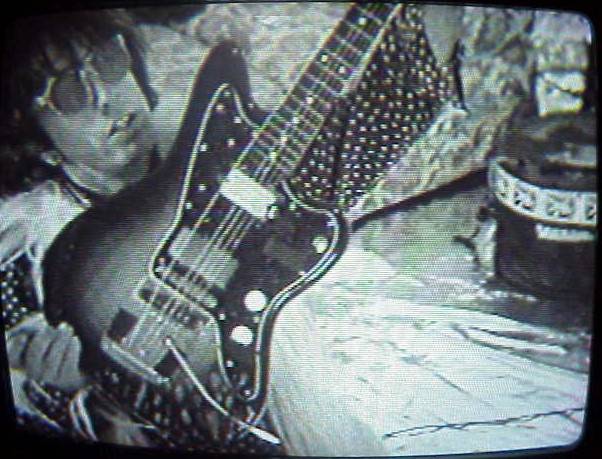
Who is John Anthony Gillis exactly? Well, I'd say he's the one above with the studied pout and vacant stare, but that wouldn't really help, would it?
Anyone who's paid even vague attention to this webpage knows that I am not a fan of Jack White - not of the White Stripes, nor of the Raconteurs, nor of that hammy underwritten track where he & Alicia Keys stand around and shout a lot. Now, bitching about mainstream music is tilting at windmills: no matter how shitty, it ain't gonna change for some crank with an obscure vinyl collection, so sit back and let the harmattan of history sand the chrome off the latest novelty until it's as rusted & useless as all that went before. But Jack White is cannier than your average pop mouthpiece and displays both a stylistic percipience and business acuity to rival that of career(ist) icons Bowie and Reznor. The White Stripes may have reached both the platinum & gold sales thresholds but once in America, yet consider that since "Fell In Love With a Girl" first gatecrashed MTV in 2002, we've been subjected to saturation airplay of Avril Lavigne, Linkin Park, 50 Cent, Norah Jones, Usher, Maroon 5, Kelly Clarkson, the Killers, the Black Eyed Peas, the High School Musical soundtracks, Amy "My Last Name Is an Easy Punchline" Winehouse, and Katy Perry... and through it all, Jack White has remained more consistently credible and popular than any of those acts.
To give credit where it's due, Jack White is a hell of a businessman.
White knows pop begins with (and doesn't go much further than) its facade, and so painstakingly sculpts his acts to look how they sound: the peppermint insouciance of the bratty White Stripes (“the most powerful color combination of all time, from a Coca-Cola can to a Nazi banner”); the tweeds-'n'-jeans bar-band antiglam of the Raconteurs; and most recently, the sallow black leather rebel peacocking of the Dead Weather (as seen above and a milliontimesbefore).
White has also learned a lesson from the Catholic Church and the Grateful Dead: what good is an image without accompanying merchandise? As far back as the Stripes' major-label debut, White's been keen to go beyond trad T-shirt-and-sticker stock by releasing limited-run collectibles bearing his trichromatic cordon. He may not have gotten his own Lego set, but he did get everything from USB sticks to sewing kits and a signature-edition Lomo camera set.
Perhaps heeding Lego's lost opportunity, the Coca-Cola company came a-knockin' in 2006 to commission an update of their epochal grouphug. The Nagi Noda video accompanying White's sub-Sesame Street singalong was an immaculately executed rip-off of Michel Gondry's fast-fatiguingrepeat-o-rama trick (including, of course, the "Hardest Button To Button" video).
But while the fool multitude may be content with wacky-looking guitars and a head-nodding beat, tastemakers, critics, and hipsters are quick to call "foul" on a musician palling around with corporate sponsors. White set about defending his cred even before any worse-than-typical-knee-jerk blacklash kicked up, cranking his Analog-Man-In-A-Digital-World affectation to 11 by slagging off "kids today" and the internet in every interview. Also, when his Bond theme was debuted via another Coca-Cola commercial, he rushed out a press release disavowing any involvement in the marketing scheme, claiming to be "disappointed that you first heard the song in a co-promotion for Coke Zero, rather than in its entirety."
But who other than the densest, most irony-deficient dolt would accept this blatant cant? (Though such blatant about-faces often seem to work for scandalised evangelicals...) Clearly White's not shy about shilling for a megacorp of questionablescruples - he just wants total control over his product. After all, he 86'd that collaboration with Lego because, in his words, "You had your chance." True, White could avoid tangling with tie-ins and licensing altogether by forsaking merchandisea la Fugazi, but then Ian MacKaye ain't got a net worth $37 million, does he?
White's technophobia & analog asceticism also rings false. The band does in fact use digital trickery to enhance their sound, and White's label's much-vaunted subscription service is - surprise! - built upon the online platform. It's this false piousness and deliberate luddism regarding the internet that is most maddening. "Do I really need a MySpace page for this fucking music?" White recently asked, and obviously no, he doesn't - but only because the Stripes (and thus all his subsequent endeavors) were one of the last acts truly to benefit from the full support of the now-shuddering machinery of the music industry. Shit, if I had V2 funding music videos and paying for airplay, I wouldn't need a MySpace page either!
If there is any other contemporary icon I consider a kindred spirit of Jack White, it's Beyoncé Knowles - which isn't to say I'll sit through a Raconteurs video just for the hip-shaking. There are other musicians who parlayed their "pop outsider" status into a self-sustained cottage industry, with numerous side-projects and forays into other mediums: Frank Zappa, Ani DiFranco, Mike Patton, and fellow Americana afficionado Nick Cave have all done this. But whereas they all regard(ed) the industry at large with enormous contempt & suspicion, White seems unnaturally at ease navigating the corporate landscape - as graceful a glad-hander as Beyoncé. Additionally, both White and Beyoncé's extra-curricular excursions seem less like creative exploration than a rapacious quest for ubiquity, that we should all die with their frizzy hair and unblinking stares seared onto our retinas, the last incandescent image we should ever see as we slump lifeless in our Laz-E-Boys in front of MTV's analgesic strobe.
But, in the end, it's all about the music, right? So yes, let's make it about the fucking music: Jack White enjoys the obscene fortune of being the most widely-admired musical half-wit in history, with a three-chord vocabulary and as great a gift for nuance as Michael Bay. As refreshingly raw as White Blood Cells may have been after a half-decade of ProTool-lacquered pop & nu-metal, White's musical aesthetic is stuck solidly forty years in the past. He's contributed as much to music's progress as these shuck-'n'-jiving charlatans.
What baffles me is that I'm far from alone in acknowledging how starkly unoriginal White's work has been, yet I am desperately alone in not forgiving his shopworn adequation. Clippings from recent Dead Weather reviews include:
See that? These days, "dead-horse devices" reminiscent of records from almost 50 years ago can still somehow be "exciting", while "done to death" merits a solid B; that's some No Child Left Behind grade-curving shit. How, how, how can such under-achieving retro-conservatism still be so gleefully consumed? Where is the otherwise-inescapable post-post-post-ironic backlash? Is everyone too scared to admit that this pallid caveman, once a compelling herald from leftfield, is actually not the fuzzbox messiah we wished? Or is everyone just THAT FUCKING BORING?
Making good on the promise of his provocative entry in the "I Hate ____" sweepstakes, Carl published a brilliant take-down of Burial, casting the clandestine South Londoner as a hyper-test-marketed lifestyle accessory to doomy cultural theorists. Yeah, I own copies of both Will Belvin's albums, but I can't say Carl's wrong - especially in calling out how "pedestrian" and "same-y" it all sounds. Debuting a full seven years after The Caretaker (which itself was theoretically-enhanced rehash of Badalamenti's Twin Peaks theme, itself already sampled of course by Moby, and down the infinite regress we stumble...), Burial is basically Tim Hecker's billowing oblivion pruned down & set to a skittering beat to soundtrack the Starbucks set. It's that (fucking overrated) first Massive Attack record reimagined for those who want something a little more zeitghost-y. It's a sound I like but have also heard before - which, of course, is the precise point, but as Carl says, that's not The Point.
Unfortunately, Carl continues & kinda ruins it by digressing into an embarrassingly naked & bitter indictment of "career artists":
Why can’t more people just pack it in and go and do something else/ take a look at themselves and decide they’re basically never going to produce anything worthwhile and not bother in the first place? ...Why do they HAVE TO make a living as musicians? I’ll happily and have happily not made a living as a writer despite having written for years and in my own estimation having a fuck site [sic] more talent than half the rubbish gets in Waterstones because if you really do care about the art you approach it full of doubt, humility and trepidation, you fall horribly and continually short...
What was clearly started with the intent of echoing Tyler Durden's eulogy for the posthistorical Everyman ultimately sounds like neither a satirical deconstruction of the star system, nor a populist manifesto for the dignity of common hard work. Instead, it comes off like the whining of a self-styled "unrecognized genius" with an adolescent sense of entitlement. Why is it anything but emancipatory to recognize artistry as just another form of nose-to-the-grindstone craftsmanship? Why must art be cloaked in cheap voodoo, restricted to the speaking-in-tongues Shock & Awe of shamanic snake oil salesmen, instead of the patient, earnest product of normal people with bright ideas? And why only cement the cultural stratification erected by the media industry by agreeing that fame is the only valid qualifier of True Art? Moaning about "why are they special?" only reinforces the illusion that they are special.
A few months ago, I happened upon this video essay (it sure as shit ain't a documentary) based upon Alvin Toffler's prescient-if-not-entirely-accurate tome Future Shock. It's more entertaining than enlightening, especially thanks to its quaintly dated standard of new hotness. Oh, and it's hosted by Orson Welles in all his bloated, furrowed-brow, uh, glory.
The video ran a lap around my social circle, giving everyone a fair chuckle. One friend in particular loved how short the film fell of its own title: "So there's Orson Welles, strolling along a moving sidewalk in some airport - smoking indoors! He can't begin to imagine the shock the future has in store for him..."
I doubt Welles (or Toffler, for that matter) would have foretold the day when smoking became prohibited outdoors, let alone in. Several of Tokyo's 23 wards (including Chiyoda, Shibuya, and Suginami) have limited al fresco smoking to designated "smoking stations", though this is meagerly enforced - at least compared to the new turf subject to the ever-expanding ban. The above picture is of a relic, a once-pervasive staple of contemporary Japanese life, already vanished without a trace: the train platform smoking station.
This network-wide smoking ban came as some surprise: not only is tobacco ubiquitous in Japan, but it's a fraction of the cost in any other developed nation (around ¥300 a pack) because the government is the majority stockholder of domestic tobacco production. My god, there's a smoking section in every McDonald's! What could possess a country so nicotine-addicted to ban smoking in all of its public transportation hubs? An Olympic bid. Gotta look sharp for all the foreign tourists & investors, after all.
But unlike the megadecibel wailing & gnashing of teeth when the EU-wide smoking ban went into effect last year, there was nary a peep out of the Japanese public. There are scarcely any notices posted in or around train stations reminding people to butt out within a hundred paces. The ashtrays disappeared, and along with them, any apparent urge to light up.
Meanwhile, my wife's been teaching a high school debate class. Parsing the list of acceptable topics, she noticed that alcoholism - a reasonably cut-&-dry (ha!) subject - wasn't mentioned. She asked if this was because it hit some of the students a little too close to home (double ha! for tasteless pun). No, mercifully that wasn't the case. The problem was that, when past teachers had attempted to explain alcoholism to the students, they didn't understand that there was anything wrong with the behaviour itself.
There are words for "addiction" in the Japanese language, and "junkie" is one of the few colloquialisms that requires no awkward translation for those minimally conversant in English. But "addiction" is understood almost exclusively in terms of narcotics. The idea that someone could be "addicted" to coffee, gambling, or internet porn is seen as a poetic embellishment. In fact, the most commonly-used word* for "addiction" (中毒 - chuudoku) also means "poisoning" - so addiction is seen less as a long-term destructive habit than an unwise short-term decision or accident.
But it's no accident that addiction, as Westerners understand it, isn't a part of Japanese pop-psychology, because when Japan admits to the detrimental effects of compulsive, unhealthy behaviour, compelled by some agency stronger than individual will, the very foundation of this society will be shattered.
In this context, smokers' quiet acceptance of the widening tobacco ban makes perfect sense: if they're not addicts, why couldn't they just wait for the train without smoking? Were smokers to argue for their right to light up, they would have to argue on behalf of their addiction; meanwhile, any opposition to the smokers would necessarily be based on the ruinous effects of their habit, to themselves and others. But once that line - from unpleasant habit to unhealthy dependence - is drawn, the etiquette & conventions that shackle so many Japanese shred like a paper chain:
Is it so important to be drafted into the white-collar army immediately after university?
Does drinking for five hours after work actually bring me closer to my colleagues?
Do I really need six beers and two chu-his whenever I leave the house to have fun?
Why is consensus more important than improving an idea by vetting competing ideas?
Why bother lining up in train stations?
Why bother registering my bike?
Why bother separating my trash?
And that's just the quotidian bullshit the Japanese put up with on top of the other issues of "civic responsibility" that raise the hackles of libertarians throughout the West. Once income tax, legalising marijuana, reforming the streamed education system, and immigration become hot topics of popular discourse, society will have become so socially pulverised that I'll be expecting looting at the local Lawson and the Tocho towers to be on fire.
(*) - Take any statements I make about the Japanese language with a grain of salt, as I'm far from fluent. I've picked up what caveman-grade speech I have from band practices, bars, and late-night talk shows.
Non-Sequitorial Addendum: I've been reading a bunch of musical biographies lately. I'm currently thumbing through Erik Morse's profile of Spacemen 3, which is basically one long anecdotal argument for doing every drug all the time (at least as far as making music is concerned). Last fall, I thoroughly enjoyed Miles Davis' autobiography, even if was basically 300 pages of "[Name of legendary jazz musician] was a bad motherfucker who wouldn't take shit off nobody!" But it's with no small amount of shame that I must confess, if only to pacify a friend's insistent recommendation, I recently read Slash's autobiography. For anyone who doesn't particularly need a roll-call of every groupie Mr. Saul Hudson banged during pre-production of Appetite, this particular quote from page 215 sums up the story nicely:
"Under the circumstances, I did the only thing that made sense: I hung out with DavidLee Roth all night."
Given that already five years have passed since he found himself "beguiled" by Coldplay, I'm probably well late in calling this, but let's make it official: JUMPED THE SHARK.
Mark "K-Punk" Fisher is the online polemical analog to Morrissey: an exquisitely-posed dilettante driven by a romanticism so cerebral & idealised that every facet of reality is met with supercilious pessimism, twinned with an arrogance that allows him to argue in favour of his (or his paladins') own failures while glibly dismissing positions or accomplishments that conflict with his imperturbably self-contained weltanshauung. Also, despite incessant use of variants of the word "libido", there's no clear evidence that K-Punk enjoys anything in a sweaty, smelly, unintellectualised, reflexively feral, excretion-of-bodily-fluids way. A Robert Christgau for British Pierrots.
Ooh, is this skirting too close to an ad hominem attack? Here are my terms for detente: instead of ducking your obligation as a critic by weakly reversing my question, Mark, please explain what is so totally uncompelling about Sonic Youth's entire 16-album oeuvre, where is this bridge between the '60s and post-punk SY rebuilt, how they've contributed nothing to the advancement of music as an art. You can lob the "tepid, flannelly, terminally uninvolving college alt-rock" grenade at, say, Washing Machine, but not EVOL. And don't detour into some More Alt. Than Thou game of The Price Is Right by "gesturing to artists more marginal" like DNA or the Dead C.
So that's it. Between the metapolitical miserablism and helping legitimise head-drillingly dull split-hair dance (d/s)ubgenres with moronic names like "wonky", I'm tuning out of K-Punk's frequency. Anyone who can turn an apology for fucking up a live mix first, into an exprobation of the ghetto set-up; second, into a masturbatory epode about a "sound [that] is in no sense normalised; on the contrary, it is volatile and eratic [sic]"... suffice to say he's on very thin ice for lambasting anyone for being "vaguely bohemian/arty middle class urban professionals" who dabble in the "most self-conscious meta-art."
...it's not my hostility towards SY that requires explanation - it's SY's hegemonic support that needs to be accounted for.
Fuck you, Daydream Nation is mind-blowing. How's that for accounting? How's that for a shattered sensus communis? Go back to your Hyperdub 12"s, stiff.
It's no wonder why print publications & word counts are dropping like birds over Chernobyl, now that "tweet" and "text" have become verbs. But if anything has rendered music writing obsolete, it's as much the critical overreach that Mark Fisher calls for (rather uninspiringly) as the consumptive nanocycle to which the relay of all information has been reduced. Yes, I'm going to tread that perilously close to hypocrisy: grossly po-faced laptop scribes are writing themselves out of relevance, dagnabbit!
Mark himself knows a bit about critical overreach - such as his touristic retreat into the realm of doom "superstars" SunnO))) that betrayed far more chin-stroking conjecture than genuine intimacy with the materials & their context. Yet, when he accuses Sonic Youth of being the first band to recycle culture into a closed circuit (as opposed to by refraction or expansion), it reads like rhetorical underachievement by his own standards. Bad Moon Rising was considerably earlier than Beck's kitchen-sink po-mo; earlier still than bland tribute acts like Mudhoney or Oasis, so points for that. But weren't there plenty of dead horses beaten to gluey pulps before Bad Moon Rising?
Punk, for example - and specifically the trichordal adolescent hissy-fits peddled by the Ramones and the Sex Pistols. Those bands made no secret of their intense affection for the eighth-note strum & clang of old rhythm 'n' blues 45s. The only wrinkle separating, say, "Whole Lotta Shakin' Going On" and "Beat On the Brat" is an extra dollop of au current, tailored-to-outrage antagonism.
Yet we can push back even earlier to proto-punk. Perhaps the Stooges' Fun House was the first retroreferential record. The elemental primitivism of rock 'n' roll's nascent wave is echoed both in spirit (the album was produced by Don Gallucci, of the Kingsmen & "Louie Louie" fame) and in sound: "Down On the Street" and "Loose" flex the same gnarly sinew as Link Wray & Duane Eddy's "rebel music", albeit with more explicit incitements to street violence and prurience.
But hell, why stop in 1970? If Sonic Youth are going to be backhanded for their "curatorial" roles, can't the same accusation be leveled at Frank Zappa? His numerous doo-wop homages were as honestly affectionate as his frequent piss-takes of contemporary artists were vicious. (Not to mention his umpteen nods to various modern classical composers.) Come to think of it, what was quintessentially new about any of the music that white musicians - Eric Clapton, Jimmy Page, Elvis, etc. - stole from Ike Turner, Howlin' Wolf, Muddy Waters, Fats Domino, so on & so forth?
But this line of argument is more than a little absurd and ultimately useless. To one degree or another, all music nods to its antecedents; torches are passed, picked up, or rekindled. Of course, music is only beholden to the past to the extent it feels the need to either worship or mock what went before. Actually, it isn't impossible to create music in a cultural vacuum, but y'know what music utterly unencumbered by historical context sounds like? The Shaggs.
Not that Mark Fisher has a problem with artists burdened by history - quite the opposite, what with his essays' manifold mentions of "remnants", nostalgia, "ghost genres", and the like. But what makes The Advisory Circle good and Ciccone Youth bad is Mark's boderline-fundamentalist adherence to hauntology. Initially an intriguing cultural phenomenon, hauntology has come to inspire the kind of unblinking fanboy devotion usually reserved for World of Warcraft and Japanese animation, which makes some of these discussions as enjoyable & open as speculating on the afterlife with a Catholic. The greater problem, though, is that hauntology is a dead end and proud of it; miserablist ruminations over doors locked and out of reach; rubbernecking backwards at all the exits along the highway we didn't take.
Well, hang on - that sounds a hell of a lot like... post-modernism. And it is! As Alex of SBA outlined it with laser accuracy, "hauntology" is fundamentally a chicken-wire fenced erected around "good postmodernism, as set against the bad PoMo of a rampaging retroism" and ironic pastiche. To put a finer point on it, hauntology is the scrapbook of the underdogs & losers of culture wars past, where as po-mo "proper" celebrates every goon who got his 15 minutes.
But I digress. I don't want to prattle on about hauntology today, especially since that conversation's already been had. I do, however, want to call attention to Mark's use of "hauntology" as some kind of meaningful aegis under which he can lump the music he likes, safely squirreled away from the music he dislikes. Clearly he's not concerned with philosophical consistency, because otherwise it'd be fuckin' nonsense to cast the Pop GroupandThe Fall as dub- and kraut-damaged conduits of primal animus & political dissonance... and Sonic Youth as mere retro-necrophiliacs. Oh, it's certainly possible to like any one and not the others, but on aesthetic terms (and even then, just barely), not philosophical ones.
This is how critical overreach functions as a crutch for petty & fickle opinions. The elaborate scaffolds writers erect provide them a form over which to drape their critical assessments; the larger & more laboured the framework, the more solid it seems. This means any bad review is given the appearance of studious consideration & self-accordant logic - a far more noble & ego-inflating position for a writer, rather than have to admit that, for reasons as inarticulable & irrational as emotions, they just don't dig something.*
Mark Fisher obviously anticipated being set upon by rabid Sonic Youth supporters like myself, adopting a Magazine song-title as his first line of defense: "My mind, it ain't so open..." I don't particularly care if Mark enjoys Sonic Youth or not. But it's bloody difficult to contend convincingly that SY are "dilettantes" who fail to "[draw] on any unconscious material" and whose cachet is derived "from gesturing to artists more marginal than them." They are inarguably one of the most influential & inventive guitar bands ever. On the one hand, it's impossible to reimagine the rock landscape of the past twenty years without their influence (or, yes, their latter-day curatorial presence); on the other, they carved such a singular niche for themselves that anyone who wears their influence on their sleeve is simply dismissed for ripping off Sonic Youth. And don't even try to claim they contributed nothing new to the conversation - I would die to hear any obvious forerunners to songs like "Death To Our Friends" or "Eric's Trip".
Is any of this reason enough to like the band? Nah, not really. But please, Mark, instead of taking potshots at a band twenty years past their peak, just say you think Thurston comes off like an aloof dick, that the beats are too loose to dance to, that the sound is all rusty shrapnel & bleating car-horn doppler. Don't say Sonic Youth are "reducible to a set of easily verbally explicable intentions" - at least not without then verbalising what those handily explicable intentions are.
Others have already rushed to Sonic Youth's defense. Zone Styx Travelcard described Bad Moon Rising place on the geocultural landscape most elegantly. Meanwhile, Simon Reynolds acknowledged the "pernicious adequacy" of Sonic Youth's decade-plus holding pattern, arguing that they've perhaps outlived their usefulness for those who keep "keen the blade of one's dissatisfaction, one's impatience." But he still called for Sonic Youth to be afforded what respect they've earned:
[SY's late-'80s run was] a gorgeous noise where No Wave's stringent modernism merges with numinous psychedelia (a new psychedelia, one that barely references anything in the vocabulary of Sixties rock). As irritating as they can be that shouldn't be taken away from them. One might even feel an empathetic twinge for the vanguardist hoisted by their own reinvention-of-the-guitar petard and faced with the problem of reinventing themselves. Why shouldn't they be like Neil Young, an alt-institution, criss-crossing back and forth within the range of sound they've established?
Of course, none of this appears to have persuaded Mark Fisher, who steered largely clear of critiquing the music itself, instead making a series of contextual accusations that could just as easily be leveled at some of his favourite artists. ("Curators... who can turn a notionally ignorant audience on to cool stuff"; "so pathologically well-adjusted that the music doesn't appear to be performing any kind of sublimatory function for them"; etc.) At times, he appears to deliberately misread Sonic Youth & their place/purpose on the musical landscape, such as when he casts them as an unworthy contemporary standard for "experimentalism" - I don't know anyone obnoxious enough to call the concise pop songcraft of Rather Ripped "experimental". There's something in his tone of a kid who lost cred because he didn't "get" something cool, and now he's come for his revenge.
Ultimately, Mark is picking the wrong battle. When he noted that "the problem with hauntology is its association with a defeated (and defeatist) leftism," he perhaps forgot to what the left owes its apparent & ongoing defeat: the left spends all its time bickering amongst themselves & atomising into combatant factions, each too marginal to function as a foundation.** Meanwhile, the right quashes its petty infighting and rolls out the heavy artillery, intent on little beyond crushing their enemies. Over the hill as they are, Sonic Youth are far from the most stifling, conservative presence in music culture. What other musicians past a half-century in age have remained so curious & engaged in contemporary underground culture? You really want to strike a blow for modernism & encourage breakthroughs into new paradigms? Impatient to hasten the close of one chapter so that we might start a new one?
Kill Jack White.
(*) - Naturally, it works both ways. Not only can critical overreach perform the semantic sleight-of-hand to excuse not liking something for insubstantial reasons, it can also cast the most negligible mediocrity in the most elysian light. After you've called attention several times to the fact the emperor is buck-ass-naked, and several people have insistently shut you up, instead praising his regal & luxuriant threads, you become fairly certain that everyone knows this guy has no clothes - they just like looking at naked people. So it is with music: surely no one's genuinely convinced that the Arcade Fire or Deerhunter are geniuses, but we like to claim so (at length & ad nauseum) just so we can sound more sophisticated that arguing, "It's got a good beat and I can sing along in my car like an asshole."
(**) - Of course, the problem of critical overreach affects political activism too. When parallels are drawn between Ian Tomlinson and Rodney King, Sean Bell, or Burma, it not only cheapens true horror, it sounds histrionic, a cry of "Wolf!" when a chow is sighted. Obviously I'm not condoning physical intimidation by the police, for chrissakes, but am I alone in thinking that Tomlinson (appearing less-than-sportif) might have just pulled a Jim Fixx by total coincidence?
Shortly, I'll be posting camcorder footage of Barack elbowing a middle-aged protester in the back - but cool your jets, Antifa bandwagoneers! That middle-aged malcontent happens to be Dick Morris! Oh, what is an uneasy confederation of libertarians & social-democrats to do?
All these mixed messages are making me thirsty. Better crack open of o' these Rockstar energy drinks... *fssshht* Aaaaaah! The sweet, cough-syrupy taste of hate...
Well, never have my own words tasted so succulent. As I was writing about unwarranted hostility and being "in an uncharacteristically conciliatory mood," the Lehman Brothers financial-services firm filed for the biggest bankruptcy in American history - and thecrowdgoeswild! Now the word is that the US gub'mint is about to pull AIG off the ledge and wrap it in an $85 billion security blanket to avoid an immediate sequel. I suppose one $691 billion giant biting the dust will have to do for our September dose of schadenfreude. I wonder if, once I roll my wagon eastward at year's end, I won't be followed by hordes of refugee financiers and carpetbaggers flying the flag of F.I.L.T.H. - "failed in London, try Hong Kong."
As good a sarcastic chuckle as this has been, there is a shadow cast across our little anti-capital celebration, as a grim spectre was invoked on the campaign trail. Eric Rauchway knows the seance:
Responding to the collapse of several major investment banks this week, John McCain reassured us, "I think still -- the fundamentals of our economy are strong." That move comes from an old playbook: On Oct. 25, 1929, Herbert Hoover declared, "The fundamental business of the country, that is the production and distribution of commodities, is on a sound and prosperous basis."
As Ezra Klein duly elaborated, "This is a guy who has said, proudly, 'I'm always for less regulation' and ...who, three years ago, wanted to turn Social Security over to Wall Street." And should you, even for a moment, find yourself deaf to the echo of Hoover, I'd point you in the direction of Lenin's Tomb for a swift reminder: "This crisis is rooted in the fundamentals."
Anyway, my modest goal for the week is to make a mix of musical misanthropy before I'm back off to Berlin. Currently in the capital is an art exhibition called Exactitudes, "a taxonomy-in-progress of street style," according to Momus. In spite of my sartorial ineptitude, I actually fit into one of the project's tidy tribal pigeonholes - archetype #19, Vagabonds, within which I am frighteningly similar to this guy. Were he wearing a John Lennon mask, he'd be a friggin' dead-ringer. Ignoring that whittling the breadth of the human guise to 96 "tribes" is still woefully insufficient (I know about three people who could conceivably be found in the Exactitudes chart), I'm a little disturbed by how the project casts appearance as an elected self-symbolisation, not as a product of circumstance & lifestyle. As though everyone from the religious devout to trustafarians, from yuppies to genuine street people, put equal consideration & effort into how they present themselves - and have access to the same kinds of tools & accessories to sculpt their exteriors. This looks awfully like more condescending poorism, though since it's billed as an "art exhibition" instead of a glossy multipage advert, I doubt it'll ignite the appropriate level of ire.
Last Thursday, I thought a simple, unadorned post of Laurie Anderson's eerie "O Superman" would be enough to mark that ugly anniversary. I thought - for once - I'd play it mature, tasteful, restrained, understated; I was almost proud for having pulled it off.
AndthenIhadtospoilitallbyidlyclickingaround. Tripping my hair-trigger temper (that would qualify me for the Republican candidacy), I immediately set about compiling a deliberately tasteless mix - some N.O.U. "Target USA" here, a li'l Cassetteboy there, topped off with a little BJM for good measure. But little by little, my rage dissipated between constant dashes to & from the Mr. Coffee in the kitchen. Who, precisely, was I exacting some psychic revenge upon? What would this achieve, other than making myself smug for my detached political superiority and trivially diverse music collection? By the time it came to master the mix, I felt appropriately like just another dickhead with a digital soapbox.
In an election year, it's easy to become prone to hysteria and overreaction - especially when some man-sizedress-up doll has swiftly castrated liberals' momentum and lent reactionaries some inauthentic-yet-iron-thick deniability. The growing dread is that November 4th will soundly prove H.L. Mencken's cynical theorem "that the common people know what they want, and deserve to get it good and hard."
At which point, there will be plenty of time for spittle-drenched diatribes about what a buncha blinkered rubes the American people are. But over the past week or so, I've seen enough misdirected hostility & troglodytic prejudice to have put me in an uncharacteristically conciliatory mood.
A friend of mine recently related that his own German students admit that, while exemplary as tourists abroad, Germans can be less than culturally accommodating at home - to which I'll testify.* Any derision I'd received in the past, I was willing to chalk up to the country's reputed wooden stoicism, but within a single three-day span last week, I'd found myself:
having not only to delineate the difference between Chinese, Japanese, and Koreans, but defend East Asians in general as having souls to a self-professed "hippie chick."
arguing that, biological complications aside, gay couples should have the right to raise a child. (This, I might add, to a divorced man who has adolescent offspring he sees maybe annually.)
being tongue-lashed by a cop for not speaking proper German when I was attempting to report some domestic violence in a neighbouring apartment.
Speaking of pigs, the most bemusing facet of "Palinoia" is her sex-symbol status. Her austere sense of dress coupled with her enthusiasm for firearms fits very neatly into every neocon's fiendish, two-faced S&M fantasy: a Madonna as magistrate & mother, and an M-16-toting minx in the marital bed. Meanwhile, confused confessions of attraction from the left probably owe a lot to the recent near-ubiquity of that other auburn-haired, bespectacled boss-lady, Tina Fey. I'll cop to Ms. Fey being the closest thing I've had to a celebrity crush since Melissa Auf Der Mauer** way back in high school; so I'm biased when I'd say the resemblance, though inescapable, is... er, charitable. But the brain-VS-loins cage-match has since been inflamed, as Fey's uncannily accurate impression of Palin on the season premiere of SNL "supercharged both the 'rah rah 9/11 boom bah' and the 'hate-fuck' sides of America’s collective brain" (to borrow the words of the Onion AV Club).
Tangentially, it was at the same party where I was called to argue that gays & Asians are people too that I inadvertently introduced both "hate sex" and "grudge fuck" to a friend's vocabulary. Though the concept of grudge-fucking put her right off, she immediately took an interest in "hate sex" and, ex-psych major that she is, asked me to expound. I began by reciting from memory - as best I could - this personal ad from Craigslist. (The cherry on top: "Your pictures get my smarmy pretension.") As best I could explain it, "hate sex" is the better of the two viscerally-exorcismic responses to someone utterly repellent; the other response, naturally, is violence.
While this reasonably sated her curiosity, my friend wanted an illustration more concrete than some idealised personal-ad respondent; Palin (having just won the Veep nom) was the obvious exemplar, though I hastened to endorse Dana Perino as my political siren du choix.
Most terrifying is that the American election won't be a potentially historic ideological battle, but a libidinal referendum.
(*) - Obviously, this isn't making a blanket statement about Germans being latent racists. C'mon, I'm not dumb enough to fall into that hypocrisy. The degree of icy aloofness (with regard to casual social interaction) also varies rather wildly from city to city: Berliners tend to be more forgiving regarding language, and Kölners are so damned cheerful I wonder if the Rhine is dosed with Prozac.
(**) - Yes, I wrote & recorded this when I was 16. That's my buddy Dan singing.
 So Whitney Houston dies and suddenly everyone gives a shit about the foghorn-voiced cokehead who gifted us with the only vocal performance more oppressive than Celine Dion's Titanic theme. How sadly predictable; how pathetically mawkish. Why does everyone rush to recall their Edenic first impression of a once-formidable talent once that person has crashed, burned, and kicked the bucket? Is it the public's way of absolving their own guilt for having used the fallen celebrity as a feeble punchline for the final decade-plus of their life? Despite the fact that some of us had problems - both aesthetic and political - with the woman from the very start?
















.jpg)




 Posts
Posts