Showing posts with label Fear. Show all posts

Saturday, February 04, 2012

Propping Up a Papier-Maché Diety

Where oh where to start? We've got the reignition of unrest in Egypt; fresh massacres in Syria ahead of a potential UN Security Council resolution; Russia fucking with said resolution whilst insisting others stop fucking with Russia (an imperative with which not even Russians are content to comply)... so much going so terribly wrong (as though that's news), what shall we examine & precisely curse this day?

Rising tensions with Iran! The sabre-rattling grew to a cacophonous din this past Thursday when a Washington Post piece revealed concerns within the Pentagon that Israel "will strike Iran in April, May or June" - to which Israeli officials replied by complaining about how itchy their trigger finger is getting.

This comes mere weeks after the absurd geopolitical blind item, "Which U.S.-baked Middle-Eastern spy agency is murdering Iranian nuclear scientists?" Mossad has shrugged off these accusations with the deflection that, while it may or may not have blown up a scientist or two, Iranian agents are definitely attacking Israeli covert operatives in retaliation.

Of course, clever commentators will note that Iran's nuclear program is the MacGuffin within this tangled yarn: the real engine of all this amplifying hostility is oil. After all, America & Israel can abide other potentially hostile nations possessing nuclear technology (Pakistan, China, France) but neither America, Israel, the EU, nor any other Occidental nation can allow any one nation a stranglehold upon the Strait of Hormuz, through which 20% of the global oil supply is exported.

And yet that's still just the skin of the issue, not the bone & meat. The biggest war drum being beaten is the survival & primacy of the Petrodollar. For over four years already, Iran's had the gall to establish its own oil bourse and sell crude in currencies other than the dollar. Japan, the world's No. 3 consumer of crude, signed up immediately (a decision which seems very prescient given the dizzy heights to which the Yen has recently risen). Less than a month ago, Russia (the world's fourth-greatest consumer of oil) and Iran announced that they'd ditched the dollar to conduct bilateral trade in their respective national currencies.

But the real game-changer came days later when Indian officials opened talks with Tehran to purchase Iranian oil with gold. Many observers think this move ostensibly gives permission for China - second only to America in oil-consumption - to follow suit. That would mean four of the six oil-hungriest countries on earth had abandoned the dollar as fiat currency. This could become the first domino to tip in the eventual collapse of the American economy. But the choice of gold as the new default currency is what has excited the fertile, frayed imaginations of conspiracy-spinners & online paranoids:
The sale of Iranian oil for gold is a mortal blow to any plans by the globalists to replace the fiat dollar with some other “new and improved” fiat currency. If India and China are allowed to start paying their debts with gold, the next “world reserve currency” could only be gold. No more fiat currencies. No more “spinning money (fiat currency) out of thin air”. No more big governments. No more central bankers.

...I doubt that the globalists will allow the gold-for-oil deal to go through. They won’t attack China or India, but the deal would be easily terminated if Iran were invaded, destroyed and stopped from selling its crude oil to anyone for anything.

...With or without pretext, the globalists will invade Iran as a matter of survival.
Of course, visions of a gold-paved future unshackled from the N.W.O. are as much cotton-candy fantasy as the dollar's worth. The only value that may be assigned to gold that cannot be assigned to any paper currency is physical scarcity, but gold's exchange-value is no less phantasmic.

What is real, what will not evaporate into smoke overnight, and what will put up a motherfucker of a fight is the American empire. Remember, this is a country whose citizens have been known to shoot gas station attendants rather than pay after pumping when prices peak above $4 per gallon. Now imagine what this country would do to avoid the pant-soiling mayhem that would result in hyperinflation & a flood of useless T-bill trash, were certain other nations to buy oil with alternative currencies.


For a succinct (if somewhat maddened) history of the Petrodollar & its geopolitical victims, please read Michael T. Winter's essay over at RT - my personal favourite site for anti-Neoliberal muckraking, though fuck if you'll find a word about any domestic Russian unrest.

Wednesday, November 09, 2011

Neither a Conquest, Nor a Vocation

Almost two months have passed since the inception of Occupy Wall Street, which is more than enough time for everyone to take sides according to whether or not they sympathize with anti-corporate collectivism. Thus far, public opinion (though hardly unanimous) is more supportive of OWS than its Old Testament-meets-Wall Street libertarian dopplegängers, the Tea Party. This is meaningful because OWS and the Tea Party cannot be arbitrarily substituted for one another. True, they're both nominally anti-establishment populist uprisings, but that's as revealing as remarking that Jim Jarmusch and Chris Columbus are both successful caucasoid filmmakers from Ohio. Only the most facile & disingenuous among the commentariat pretend there's meaningful similarity between OWS and the Tea Party - a comparison so paper-thin that it can be debunked in about nine bullet-points augmented by flashy graphics.

Objectively, OWS is far easier to sympathize with than the Tea Party, and not simply because the former has refused the latter's embarrassing reliance on Nazi similes and racist imagery. The Occupiers themselves sympathize with the unemployed, the indebted, the working poor, and struggling families around the world, whereas the Tea Party sympathize with precisely no one. Their philosophy is equal parts Horatio Alger & avarice; they've infamously bayed for the blood of the incarcerated & the infirm; and the bootstrap-pulling pugnacity of the "We Are the 53%" blog reads like a suicide pact with the free market, inadvertantly highlighting the very tragic inequities that OWS seeks to correct.

So at the risk of surrendering to these Fountainhead-cases enslaved by Stockholm Syndrome to capitalist rapacity, why can't I offer my full endorsement to the #Occupy movement?

So far, I've been conspicuously silent about Occupy Wall Street, both online and off. After all, it's difficult to debate tactics & policy when there's little evidence or exercise of either: the very term "movement" implies momentum and direction, neither of which OWS has. The fraternal occupations that have sprouted around America & across the Atlantic are growth, for sure, but less snowballing locomotion than an entropic clustering of mass. The greater the Occupiers' numbers (or the greater the appearance of their numbers), the safer & more attractive it is for others to join their ranks. The Japanese have a saying: the more people running a red light, the less there is to fear. (Evidently, the Japanese have been to Baltimore.)

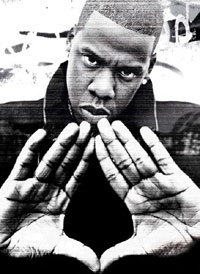
For all the attention & swelling attendance, I suspect the reason OWS has yet to win the majority's support is because it appears as a closed operation. It doesn't matter how inclusive the message or sentiment is when the Occupation is conducted via theatrical arcana and insular code: anyone who doesn't understand the symbolism of wiggling fingers, doesn't know what a "human microphone" is, or doesn't understand why the Occupiers keep throwing up Jay-Z's hand-sign is definitively outside the movement. I understand that creating rituals & codes are integral to a group's cohesion & identity. It's also what cults do precisely because of the divisive, exclusionary function those rituals & codes serve. Stephen Colbert's "field report" on Occupy Wall Street demonstrated this: relatively straightforward questions, refracted through the liturgical jargon of the "movement," became an impenetrable fog of Newspeak that failed to address such simple concerns as what's on the agenda.

Colbert too noted that they "seem like a cult."

Dogged adherence to process is proof of both an abiding civility and an intolerance for radicalism. For a "movement" that doesn't want to recreate the flaws of corporate hegemony, they've taken very quickly to restrictive & stifling discursive codes. In fact, this legislative orthodoxy explains the lack of any specific, articulable demands: as a heterogeneous assembly, the Occupiers refuse to presume any one demand would be adequately representative of, or beneficial to, each of the participants. Tasks are delegated, but representation never exceeds the level of the individual. They've even formed caucuses to promote "marginalized voices" within the "movement." As though the plutocrats give a shit about the diversity of their serfs. Patient acknowledgment of every demographic peculiarity looks good on the recruitment pamphlet, but it's arboreal taxonomy at the expense of the forest. If no collective action can presume to demonstrate the communal will, then the Occupy "movement" is merely a motley form of group therapy, the scattershot yawp of recession-scarred consumers.

When Colbert asked (with uncharacteristic earnestness) how he could be part of Occupy Wall Street, Justin Wedes replied, "You need to come down to the park, Stephen... you need to make your voice heard." Well, to stand & be counted is only an effective political act in a representative democracy, which America absolutely is not. (To say nothing of the likes of Harper, Cameron, Sarkozy, Berlusconi, Putin, or whoever the Japanese Prime Minister is today.) Has the "movement" already left no room for invention, adaptation, or a more aggressive engagement against capitalism? To wit, the Occupiers have issued a blanket condemnation not of corporations as malignant entities, but of the defacement or destruction of corporate property - reifying the very system the Occupiers claim to challenge!

I understand that it's too much to ask that someone had a readymade wholesale ideology with which to replace capitalism. But if we make no demands, then we can expect to make no progress either. What's essential is the exercise of imagination beyond what is expedient, practical, or indeed attainable. If we refuse to take "no" for an answer, then we have to ask questions that cannot be answered thusly. Naturally, we don't want our goals reappropriated & assimilated by capitalism as it reforms & resurrects itself in response to the current crisis. But this, Howard Zinn would remind us, is a dilemma that leftists has faced before:
It is hard to say how many Socialists saw clearly how useful reform was to capitalism, but in 1912, a left-wing Socialist from Conneticut, Robert LaMonte... suggested that progressives would work for reforms, but Socialists must make only "impossible demands," which would reveal the limitations of the reformers. (A People's History of the United States, p.354)
That is, of course, assuming that Occupy Wall Street are sufficiently radical or ambitious to want something other than merely a kinder, cuddlier form of global capitalism.

Sunday, October 09, 2011

We Are All Big Brother

As my existence in meatspace has elaborated & unfolded into an every-wider array of activities & obligations, I've felt less guilty for letting this space lapse into occasional torpor. There's always some guilt, given that I know there are a few kind individuals on the other side of the internet who actually pay attention to, think about, and even respond to my self-indulgent wortschwall. I honestly enjoy their participation and so feel neglectful, even ungrateful, whenever my side of the conversation slips into silence.

Some of my friends - real friends, not "friends" or Friends™ - ask why it's been so long since I last posted regularly on this blog, to which I can only reply, "Because I'm talking to you right fucking now!" Point taken, they suggest that perhaps I sign up for Twitter or Tumblr and start "microblogging" if full essays are too burdensome. But I find that thinking & conversing in bite-sized nuggets leads to a kind of mental constipation. Besides, I don't have a cellphone (the ultimate act of roguish delinquency here in Japan) to enable such incessant content-regurgitation.

So reality took precedence over my online presence for the past couple of months. A significant factor was that my band's current effort to release a record had turned into a blunder-plagued clusterfuck. (You know you're in trouble when your contact at the record-pressing plant is an accountant, not a technician.) But the bulk of my time offline has been on the road: my band has played more shows over the preceding month than we did all of last year. However, it wasn't simply that incessant touring kept me away from the computer and that explains my absence; there was a particular phenomenon recurrent on the road that made me want as much distance from cyberspace as I could get.

Over the past two years in Japan, Twitter has gone from marginal novelty to ubiquitous modus vivendi: the estimated number of Japanese "tweeters" exploded from a mere 200,000 in January '09 to over 16 million by August '10. Japan holds the current record of 6,939 "tweets-per-second" and sends around 14% of all "tweets" despite comprising only 8% of Twitter's user base.

This can produce some peculiar social dynamics in the "real" world. I've lost count of how often I find myself sat at a table, surrounded by friends, utterly ignored as they, every one of 'em, thumb-tap away on their Twitter accounts to tell thousands of anonymous voyeurs what a kick-ass time we're all having "together."

But that's simply a dull annoyance. What I find disturbing is, thanks to the Japanese fondness for interminate & omnivorous tweeting, I've been assimilated into the Twitterverse without even trying. This past July, I was chatting with some acquaintances after a show in Nagoya. In the midst of the usual catch-up chit-chat, one of them asked me, "So how did you like your lunch? It looked super-American!"

I didn't quite understand. "Super-American?"

"Yeah, you know - your wife prepared you a lunchbox with pizza and a green apple. That's a totally American thing to eat for lunch; Japanese would never eat pizza for lunch!"

My initial offense at being mistaken for an American was very quickly overcome by befuddled panic: how did they, a relative stranger, know what I'd eaten for lunch in such detail? Yes, I had eaten pizza & a green apple that my wife had stuffed into tupperware for me, but I'd done so sat under a tree in a rest area 120 miles away from Nagoya in the company of only my band's bassist...

Then it hit me. "Ken put a picture of my lunch on Twitter, didn't he?"

This was only first of what have become regular intrusions on my quotidian activities that I'd like to think were autonomous & anonymous. Last week, I arrive in Nara after an overnight drive to discover that a fellow traveler had shared a snapshot of my slumbering form with his 1,500 Twitter followers. This isn't to say that on-the-road naps & snacks are embarrassing in & of themselves, but it's upsetting that even such boring & inconsequential activities cannot escape the all-seeing eye of the electronic multitude.

The obsequious cliché is that if you've nothing to hide, you've nothing to fear, but the nefarious implication therein is that if you did have something to hide, you wouldn't be able to. The flipside of the superficial "empowerment" of social media's self-expressive potential is that it creates a volunteer surveillance state. There is no need for informants, spies, or state-sponsored treachery when citizens opt-in to the Panopticon - a truth sadly demonstrated by how the Iranian government turned the 2009 "Twitter Revolution" against itself in its crackdown upon self-documenting dissidents.

Insofar as "rights" are merely privileges bestowed by the state upon its subjects, privilege cannot exist except in contrast with its opposite, penury. As Jean Baudrillard argued in The Consumer Society, "rights" become legally sanctified only at the point that they become recognizable by their punctuated & selective absence:
This whole phenomenon, which seems to express a general individual and collective advance, rewarded in the end with embodiment in institutions, is ambiguous in its meaning and one might, as it were, see it as representing quite the opposite: there is no right to space until there no longer is space for everyone, and until space and silence are the privilege of some at the expense of others. Just as there was no `right to property' until there was no longer land for everyone and there was no right to work until work became, within the framework of the division of labour, an exchangeable commodity, i.e. one which no longer belonged specifically to individuals.
This is certainly why arguments about the "right to privacy" have become more commonplace & heated concomitant with the rise of the internet & global telecommunications. As opposed to privacy of physical property (the long-enshrined fundament of liberal democracy), privacy of deed & thought are of greater value & concern the more impossible they become under the ever-widening purview of the self-imposed surveillance state.

To the extent that I expose myself online, I may be justifiably subject to ridicule, argument, censure, or acclaim much the same as I may be for picking a fight in a convenience store, being a drunken lech at a wedding reception, or helping an old lady cross the street. We're judged by our public performance, online and off. What has changed is that I - we - no longer have control over which aspects of our lives are subject to public scrutiny, because even if I choose not to broadcast a certain deed or thought across the internet, I cannot stop my friends/"friends"/Friends™ from doing just that.

Sunday, March 13, 2011

Pick Up the Pieces

Well, I was about two edits away from completing posts about the ongoing guitar-solo battle and America buttoning up its brownshirt - but given current local circumstances, both those topics seem, if not irrelevant, low-priority.

When the quake hit Friday afternoon, it took me about 20 seconds to realize this was not an average tremor: instead of the normal side-to-side shimmy, the ground was undulating in an unnervingly fluid manner. That it hadn't stopped after 20 seconds was an even worse sign. Not wishing to die pancaked under concrete, I dashed out into the street. I couldn't immediately tell quite how frightened I should've felt: my neighbourhood is populated largely by stoics, slackers, and seniors, all of whom were stolidly standing around watching the streetlights & stop signs rattle and groan. Taxi cabs and bicyclists obstinately struggled to steer straight as the asphalt warped beneath their wheels. Was this a fucking disaster or not?

Once the shaking stopped, I ran back inside to find my apartment totally intact - a minor miracle, considering its seemingly-shoddy construction and our laissez-faire approach to storage. Returning to my computer, I noticed my Caltech scientist friend had just logged on. I broke the news, to which he replied with the appropriate amount of incredulity:
me: Dude, we just had the biggest earthquake I've ever felt.
Scientist Friend: !!!
you ok?
hasn't shown up on my feed yet
me: No, I mean like JUST hit.
Scientist Friend: oh shiiiit
We then spent the better part of an hour swapping links & updates as information began flooding in... 7.9, epicenter near Sendai, 8.8, tsunami warnings, 8.9, the largest earthquake in Japan's history. This was a fucking disaster.

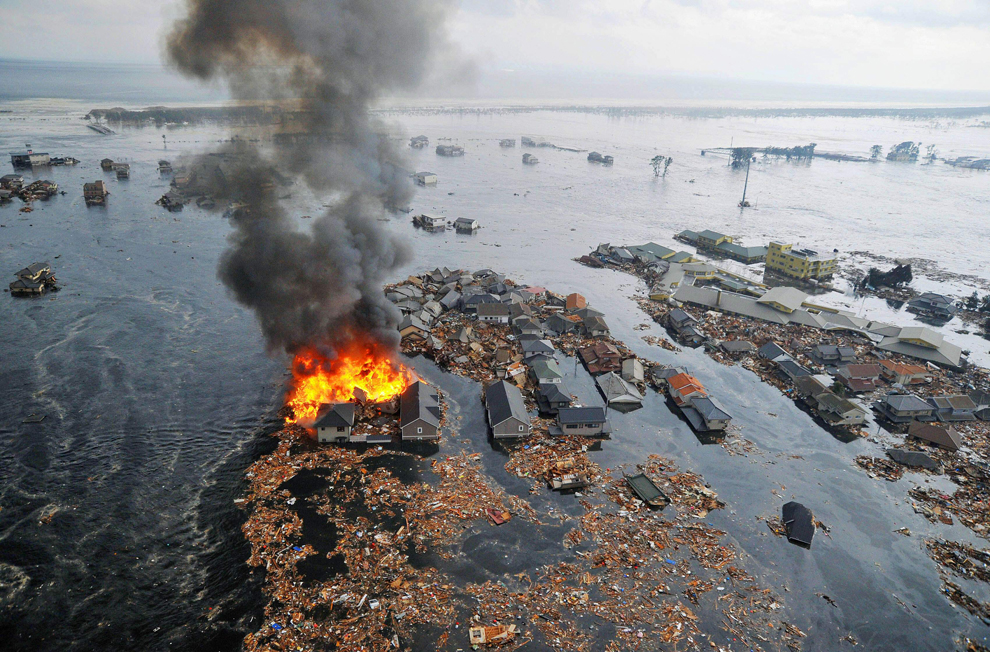
Wow, what an grossly unsuitable turn-of-phrase I just used. "Flooding in..." Less than an hour after the quake, I sat slack-jawed & stupefied watching live coverage of tsunamis bulldozing whole towns along the Pacific coast. There's no point in trying to describe the sight. Not only has the 24-hour news cycle chiseled these images into everyone's retinas, but there's no joy in, uh, eloquently and succinctly relating the deaths of hundreds, maybe thousands of people.*

Having had my fill of calamity-porn infotainment, I stepped out for some fresh air. The streets were eerily empty for a Friday evening. With mass transportation at a stand-still, everyone was still stuck at work. The signs of catastrophe were quietly obvious, as most shops were either shuttered or sweeping up their shattered wares. (As unpleasant as it is clearing away smashed liquor bottles or ceramics, I can't imagine how exasperating it must be to tidy up a pachinko parlour after an earthquake - ball bearings all over that sumbitch...) A couple of billboards threatened to fall from their perches. The ferroconcrete facade of one shop had collapsed, exposing the building's dainty wood skeleton. But mercifully, Koenji had escaped the quake largely unscathed.

Later Friday night, my wife & I were interviewed by CBC Radio as "eyewitnesses" to the disaster. We were dramatic enough to keep our account interesting, while at the same time emphasizing how little we could justifiably complain. Our misadventure wasn't a pale shade of the terror experienced by residents up north. We were speaking from a heated apartment with hot coffee and clean socks - how bad off could we really be?

Yesterday was a gorgeous blue-sky day with the resiny chill of early spring in the air. A friend & I enjoyed a lengthy hike across Western Tokyo to cure ourselves of cabin fever and the lingering stink of apocalyptic presentiment. However, whatever cheerfulness we'd won during the walk evaporated upon arrival at a friend's house, where we learned that the Fukushima Daiichi nuclear reactor had just popped its top. Our immediate course of action was obvious: start drinking like a bastard and pray the jet stream would whisk any & all radioactive toxins up over Siberia, because fuck reindeer, man.

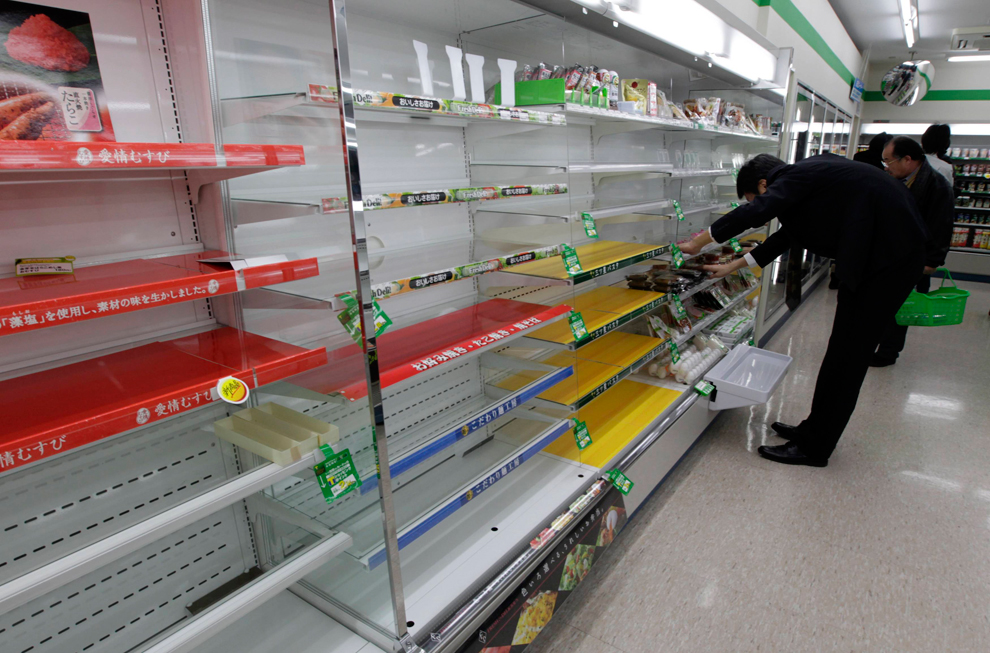
I was spurred to an early retreat home by sudden rumours of rolling blackouts and supply shortages. I must have been slow off the blocks because already there was not a slice of bread, not a carton of milk to be found in any shop I entered. Faced with such a depleted selection, many shoppers had opted for foodstuffs that would strike a penniless college student as grossly unhealthy: boxes of Frosted Flakes, microwave pasta, chocolate-covered potato chips, and enough six-packs to make the U.S. marine corps plotz. I suppose diabetes kills you slower than starvation.

Today, further steps towards normalcy have been made. Electricity, gas, and water are still running. Bread & milk are back on the shelves and the trains are on time. But again, I speak from the privileged position of the resource-greedy capitol almost 400km from the epicenter. The slowly-unfolding horror of nuclear meltdown continues, and the people of Tohoku are in desperate need of assistance. If you're so inclined, donations can be made to the Red Cross and Globalgiving.org. It may seem unlikely that a first-world nation would so be in need, but remember: this is a first-world whose debt is over twice the value of its GDP with a population so aged that it makes the SCOTUS look like spring chickens. If the West still wants someone to manufacture semiconducters and service the American national debt, then help is absolutely necessary.


* - Having neither a television nor the interest, I haven't really watched CNN outside of hotel rooms until this weekend - wow, I had no idea they were such a lousy network. Not "lousy" meaning "transparently propagandist," à la Fox News, just straight-up bad. They've got analytical prowess of a 10-year-old and the emotional tenor of Woody Allen after a bout of heavy drinking. The spectacle will no doubt reach its faked climax Monday night when Anderson Cooper will stroll around the demolished mise-en-scène where the news used to be, feeling the story at us. Ugh.

And I swear, come Monday, if Stewart or Colbert falls back on one goddamned Godzilla joke...

Friday, March 11, 2011

All Shook Up

Well, I'd have a lot more to say about this if there weren't still aftershocks rattling my apartment. Watching live footage of tsunamis wipe whole towns off the map in Miyagi prefecture. Absolutely terrifying. (Roland Emmerich really is a fucking pornographer, isn't he?)

8.8, they're saying - larger than the Great Hanshin Earthquake of '95, one of the largest in recorded Japanese history. Carl, hope all is well down your end of the country.

This planet is bullshit, man.