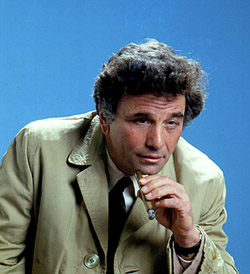
 Fare thee well, Peter Falk. I can't convey with any dignity or elegance how much I genuinely fucking love Columbo. I've not been so mortified since Patrick McGoohan's passing.
Sunday, June 26, 2011
Just One More Thing...
Generally, I'm suspicious of people who are diligent in cataloging the birthdays & deaths of the better-known among us. It betrays an insipid nostalgia and a cloying, desperate hope that they themselves will one day be remembered fondly & eulogized flatteringly. Death: get over it, eh? But at the risk of hypocrisy, I can't allow this to slip by unnoticed...
 Fare thee well, Peter Falk. I can't convey with any dignity or elegance how much I genuinely fucking love Columbo. I've not been so mortified since Patrick McGoohan's passing.
Fare thee well, Peter Falk. I can't convey with any dignity or elegance how much I genuinely fucking love Columbo. I've not been so mortified since Patrick McGoohan's passing.

Thursday, June 23, 2011
Solitaire With a Deck of Fifty-One
 Hey, why haven't you been writing anything on your blog recently?
Uh... wait, you actually read my blog?
Well, yeah, it was kinda interesting back during that whole earthquake/tsunami clusterfuckalypse. Not to mention you're one of the top hits on Google searches for "I Hate Animal Collective", "lonesome cosmonaut", and "Thijs Van Leer".* But you've more or less vanished recently, what's up?
Well, I've been busy. Most of May was recording, then it was mixing, and now it's back to gigging. I'm spending my birthday playing some nicotine-tarred, beer-stank basement outside an American military base. Which has a certain unshaven charm to it, but I'd rather just stay at home, eat some cake, and listen to this Harmonia record my wife got me. Then play it backwards to see if there's any discernable dissemblance.
That's your excuse? Two months of near total silence because you're playing with microphones and compressors? Dude, Steve motherfuckin' Albini has engineered over a thousand records and he still finds time for a food blog.
Yeah, well, that's why he's Steve Albini and I'm not. Besides, when it came time to mix my own band's album, no one had a clue what they wanted it to sound like - roomy & loose? Cold & claustrophobic? Aspirationally big? It was a long road with many detours and much backtracking.
Why not write about the whole process of making an album then?
No. Certainly not before the album's actually out. The only thing duller than specialized tech-talk is when there isn't even any music to supplement the conversation.
So that's really it, you've just been locked indoors de-essing vocals and tweaking spring reverb for six weeks?
And look how stir-crazy it's made me: I've started thinking in duologue with some phantasmic other! But recently, I also finished reading a couple of books about the internet's oppressive demand for participation and its dilution of politics. Hell, Adam Curtis just aired a new documentary series about that very subject.
That was pretty good. Except for the second episode, it lacked the narrative cohesion of his earlier work, but they can't all be home runs.
Ain't that the truth.
So you've been a bit put off of self-important polemics & pop-cultural diatribes?
I mean, how much can I really contribute to the juvenile snickering or Malcolm Tuckerish political spinning of Weinergate?
I will, however, say this about last week's riot in Vancouver: watching the chaos unfurl on live TV, it was striking that news anchors repeatedly referred to the drunken miscreants as "protestors". Protesting what? That Canucks goalie Roberto Luongo played with all the skill of three pool noodles roped together? I don't know if it was an unfortunate tongue-slip or deliberate semiotic sculpture, but either way, it's disturbing to see that "protest" being impoverished as a legitimate tool of political struggle by directly associating the word with boozy troglodytes burning cars and smashing storefronts.
Sure enough, slanderous suggestions that the chaos was in fact an opportunist operation by the Black Bloc have proven completely false: it was the work of a bunch of beer-soaked bourgeois kids who were looking for an excuse to explode.
 It's interesting to see the role social media played in the riot: on one hand, the mere presence of hundreds of gawkers wielding iPhone cameras must have egged on the more ambitiously destructive delinquents; on the other, the excess of close-range documentation did away with the anonymity of the crowd, effectively unmasking & shaming those who did the most damage. Do you think-
Look, that's a topic that absolutely merits more discussion, but I've gotta pack my gear for the gig tonight.
Okay, go on then. Well, come back soon and keep writing. If nothing else, you need the mental exercise if you're spending so much time locked indoors away from summer's swelter. Oh, and happy birthday!
Thanks.
* - I'm not making this up.
Tuesday, May 31, 2011
Not All Thoughts Turn To Words
 Curious seekers that they are, musicians' creative intentions often bleed into other idioms, and then the trouble starts. Even backed by the full might of the publicity machine, few musicians are admired for their literary prowess, thespian skill, or political acumen. For every Leonard Cohen, Kris Kristofferson, or Peter Garrett, there's a thousand Nikki Sixxes, Mariah Careys, or Bonos. The sense of entitlement that follows massive success in a specific field is the most obvious motivation for these multimedia misadventures, but it's also partially a problem of genre: rock & pop are deliberately simplistic & populist forms that often discourage experimentation or analysis. The purposeful, studious effort required to excel in any art form is likely onerous to anyone who just wants to rock.
Sometimes it works the other way: skills cultivated within a certain musical style translate well into other milieus. It's no surprise that as skilled a lyricist as Jay-Z is a decent author & thoughtful commentator; similarly, since hip-hop is all about embodying a persona, MCs often make far more convincing actors (e.g. Ice Cube, Mos Def) than musicians of other genres (e.g. Jack White, Jon Bon Jovi, Sting, etc) - though I imagine anyone who saw Get Rich Or Die Trying or How High would beg to differ.
 It may be expecting too much for successful musicians to be skilled in other artistic forms. It's a reasonable assumption that someone chooses a specific mode of communication because it comes the most naturally to them. As the art most directly related to pure sensation, music is an expression of the inarticulable. Perhaps that's why the majority of musicians flex all the verbal dexterity & rapier wit of Koko the gorilla after chugging a handle of cheap Vodka.
I'd prefer artists were at least as lucid as their audience in discussing their art. Unfortunately, there's little in a musician's quotidian routine that would necessarily encourage aesthetic, philosophical, or political inquiry. The internet is an infinitely resonant echo chamber, packed with pop-cultural detritus, from which any musician can hand-pick a grab-bag of references & aesthetic allusions without having to confront said references' original context. Consequently, Lady Gaga can name-drop Andy Warhol & Nietzsche all she likes, but her "smartest" song is barely equivalent to forebear David Bowie's dumbest.
More importantly, the current means of recording have placed an undue emphasis upon the production - as opposed to the composition - of music. As digital technology has made world-class recording tools accessible to the masses, professional recording studios with veteran engineers have become frivolous luxury. So musicians must now craft their own sound-worlds from scratch, unaided, even if they've never so much as plugged in a microphone before. The fashion in which their music is captured & represented is arguably of greater concern than even songwriting.
 This, unfortunately, leads to amateurish & underachieving performances of amateurish & underachieving tunes, because it's the only music that withstands amateurish & underachieving recordings. The post-JAMC lo-fi rock 'n' roll revival has been fueled by the fact that it's the only full-band sub-genre that doesn't sound like shit recorded one track at a time using only an SM57. I'd also argue the availability & ease of sequencing & sampling software like Fruity Loops has inculcated the moronic anti-lyricism so prevalent in contemporary hip-hop. Lo-fi, once an obstacle to be surmounted, has become a nostalgic aesthetic retreat for the musically unambitious.
This isn't to say that seasoned engineers make excellent musical directors. Gear-heads are notoriously coarse in their appreciation of aesthetics, since they can find something equally praise-worthy in either Pet Sounds (nice doubling of the piano & accordian!) or Linkin Park (excellent gating on the guitars!). But the musician-engineer relationship provided a valuable & effective division of labour: the musicians were left to focus on their artistic vision, unperturbed by technical considerations, and engineers employed their scientific savvy to faithfully capture & frame the musicians' sound-world.
Obviously, much of the best music is a synthesis songwriting and production, but it's almost never the result of vague intuition or ham-fisted fuckin' around. Those leading lights equally famed for their musical and technical prowess - Quincy Jones, Brian Eno, Steve Albini - began as musicians and gradually developed their own production styles by being inquisitive, assimilating experience, and spending a lot of time in studios. It's precisely because of their intellectual curiosity that polymaths not only craft some of the most interesting music, but are more engaging in discussion. Intellectual laziness breeds artistic laziness, which in turn spawns boring albums and bad interviews.
Saturday, May 21, 2011
Oh Noooooooo-ah!
 Even if not one single other soul vanishes today from this earth, this proves that the Rapture has indeed come. Give God the ol' figure-4 leg-lock for us, Randy!
Sunday, May 08, 2011
Great Minds
 Noam Chomsky on the death of Osama Bin Laden:
We might ask ourselves how we would be reacting if Iraqi commandos landed at George W. Bush’s compound, assassinated him, and dumped his body in the Atlantic. Uncontroversially, his crimes vastly exceed bin Laden’s, and he is not a “suspect” but uncontroversially the “decider” who gave the orders...And the immortal Bill Hicks, from Rant in E-Minor.
As for fools who never differ, Richard Metzger hits upon an idea that I myself had almost six years ago - charity porn. What's more surprising: that it took a laggardly half-decade for Metzger to experience the same epiphany, or that apparently he & I are the only people ever to have had such beneficent inspiration?
Friday, May 06, 2011
Own It
 As much as I've tried to mediate my media intake since Monday, the consensual tenor of American liberals has been unmistakable: unity! Now is not the time for partisan bickering, point-scoring, or revisionism. Now is the time for America to reclaim its sense of divine purpose, to see its pride bloom phoenix-like, and to (again) nail shut history's coffin! Everyone wave your copy of Team America: World Police in the air like you just don't care!
It's all, of course, disingenuous as hell: liberals are more than happy to engage in the kind of hawkish dick-swinging and self-aggrandizing revisionism for which they've long maligned the right-wing. So great was Obama's coup sans grâce against Bin Laden that much of the American left is gloating that they've beaten the Neo-Cons at their own game.
But chest-thumping machismo isn't a good look for liberals, nor one they're accustomed to, and so there's been the perfunctory lip-service to civil liberties, common dignity, and the rule of law. This in turn produces an aneurysm-inducing level of cognitive dissonance - hypocrisy & self-serving sanctimony so impenetrable that, for example, a single NYT editorial can proclaim that torture "violate[s] the law and any acceptable moral standard" while simultaneously asserting that "the battered intelligence community should now be basking in the glory of a successful operation."
After a decade of having been defamed as cowards, pinkos, pantywaists, apologists, and traitors, and especially now that their guy is in office, American liberals are desperate to occupy the first-person plural within "We killed Bin Laden!" Are they sure they want to put themselves at the center of the story? There is a way for liberals to indulge their id-inflamed glee while distancing themselves from the decade-long horror show preceding Bin Laden's demise. If instead of "we," they said that "a military-mafioso squad of anonymous assassins, operating outside international law, killed Bin Laden," then they'd be mere apologists (as opposed to patrons) of state-sponsored murder.
But that won't do, will it? Claiming Bin Laden's head as a trophy is an all-or-nothing proposition. If liberals are going to wear the broad-shouldered suit of the authoritarian Alpha, then they've got to own it, and I mean all of it: Guantánamo Bay, "enhanced" interrogation, Maher Arar, Abu Ghraib, the Haditha massacre, the Mahmudiyah killings, $1.2 trillion dollars, and at least 919,967 dead. Whoever claims authorship of the Osama Bin Laden's bullet-riddled dénouement signs their name to the whole, gory narrative.
Hope it was all worth it, you bloodlusty exceptionalists.
Tuesday, May 03, 2011
Meanwhile, to the North...
 Goddamn it, Canada. I thought we'd come so far. I thought, after over a century of defining ourselves negatively against our noisy neighbours to the south, we'd crafted a distinct & sovereign sense of national self. After all, our elephantine bedmate has been neither a "friendly and even-tempered" beast nor an honourable example to follow.
But no, evidently Canada wants to mirror its adjacent nation, bisecting into a fiercely polarized country whose vocal majority is composed of pigheaded reactionaries terrified of taxes. As in America, the political timbre is being tuned by retrogressive, provincial rubes. So New Brunswick, southern Ontario, Saskatchewan, and especially my fellow Albertans, I hail you in the resonant words of Mr. BDR: nation of motherfucking crackers.
However, there is a considerably bright silver lining to this otherwise dismal election: the New Democratic Party has vaulted from a modest Parliamentary presence to the official opposition. Instead of the ruling right-wingers being opposed by a bunch of milquetoast militarist corporate apologists (cf. American Democrats), they will face a socially progressive, communally-minded party with dedicated nationwide support. The mind reels pondering what hysterical smears American news organizations will chuck at the NDP, given that the American "left" falls somewhere around the middle of the Canadian political spectrum. I can already imagine fat-assed whoremonger Dick Morris calling Jack Layton a "Trotskyite."
But despite their greatest electoral gain ever, the NDP does not have an easy road ahead. This has been the wildest toss-up in Parliament's composition since 1993, wherein Chrétien swept the country, the separatist Bloc Québécois became the official opposition, and the ruling Progressive Conservatives - who once held the largest majority in Canadian history - were nuked out of existence. Today's electoral shake-up is equally shocking, especially with the NDP wiping out the Bloc. The problem is that, between the Conservative's new majority and the collapse of the Liberal Party, Layton has comparatively less influence in Parliament than during the previous minority government. Not only will he have to fight harder to rebuff the Conservatives' mandate, Layton's hard-won prominence is entirely dependent on the notoriously fickle & self-interested Quebec. If he fails to satisfy "les chialeux qui font rien," the NDP's new gains could be nullified the next time around.
But reelection schemes be damned, all that matters now is oppugning Stephen Harper, that beady-eyed oligarchic android who bleeds oil. I would like to return to Canada someday, and I'd prefer it not to have been transfigured into a snowy, sparsely-populated counterfeit of the United States. I left that country for a goddamned reason.
Monday, May 02, 2011
Breaking News!
 After a mere decade of costly, murderous effort, the largest imperial military apparatus in history succeeds in killing diabetic cave-dweller!
Wow, I can already vividly feel how the world's changed for the better.
Yep. Everything's fine now!
Update: I had no idea that a bloodied corpse getting booted out of a blackhawk helicopter over international waters counts as a burial in accordance with Islamic law. You learn something new every day!
Monday, April 25, 2011
Nothing From Nothing
Deep in the dunes of time, when the first caveman bashed two sticks together in a rhythmic fashion, music was born. When a second caveman bashed two sticks together in a rhythmic fashion, I imagine his tribesmen scoffed derisively, "Eh, that's fine, Grom, but it's just a rehash of Grog's stick-noise, innit?"
 Complaining that music has become derivative is as old as music itself - and why not? To one extent or another, all music concedes the influence of its antecedents. But new frontiers of frustration over secondhand sounds have unfolded, thanks to the omnivorous archive of the internet and what Tony Herrington calls "pop culture’s own acquiescence to the illusion of neo-liberal ‘end of history’ propaganda." The latest entry in the derivation debate comes thanks to Simon Reynolds' less-than-flattering profile of L.A.-based content-generators Not Not Fun. There's a lot to unpack in NNF's cherry-picked pastiche, and so several different conversations have developed. Marc Hogan, Mike Barthel, and Eric Harvey have all toyed with the idea of "underground music" as consumer niche (with Harvey in particular refusing the very notion that music can exist external to capitalism). Herrington's blog posts for The Wire have dissected NNF's libidinal affectations. Elsewhere, The Impostume's Carl has pulled back to the broader question of aesthetic mutability, which to me is where the rubber meets the road:
Following centuries of parochial tunings plagued by wolves, the establishment of "well temperament" excised tonal anarchy & miscommunication from European music, providing a universal language for composition & performance. Only later, when this system became ossified dogma, did composers begin ridding themselves of its restrictions. And yet in the 1970s, some experimental composers, such as Krzystof Penderecki and Cornelius Cardew, abandoned the avant-garde, suggesting that it "gave one an illusion of universalism" which, as such, could arguably serve imperialism.
Over the twentieth century, music has repeated this adoption-then-abandonment of pedantry in ever-accelerating cycles, yet each oscillation has been an effort to shed the perceived misapplications of the previous generation of music. Bebop, an elitist reaction against the populist sloth of big band, was in turn countered by more meditative & minimalist styles like cool & modal. Meanwhile, rock spent the first thirty years of its life vacillating wildly between extremes of simplicity (e.g. rhythm 'n' blues, punk à la Ramones) and ostentation (e.g. acid rock, progressive rock).
Since the early '80s, the central conversation within anti-authoritarian styles of music (in contradistinction to Pop) has been about "authenticity": is punk better defined stylistically or by D.I.Y. business practices? Has an artist "sold out," regardless of how unconventional their music is, once they sign to a major label? Are music videos an extension or a perversion of an artist's expression? What's real hip-hop? Underlying all of these questions is the subtractive impulse: artistic purity has less to do with aesthetic specifics than with erasing the corruptions inflicted by the culture industry. This is why a debut album is so often considered a given artist's pinnacle, or why so many musicians speak of getting back to a genre's "roots": their sense is that the time elapsed between inception and present has served only to distort or deteriorate.
 The subtractive impulse is immaterial because it is just that - an impulse, a motive, an intent. However, the physical means of composing, performing, and reproducing music have multiplied over the years because technology is almost (but not quite) exclusively additive. The toolbox only gets bigger; implements are never discarded, only updated & improved. One generation plows a dirt road across hostile & uncharted terrain; the next speeds effortlessly along an asphalt-paved highway.
Technology has been the engine of every major aesthetic shift, every stylistic warp, every timbral weft. The temporal limits of physical formats first dictated, then liberated conventional song structure. Amplification allowed small ensembles of amateur musicians to become icons. Voltage-controlled oscillators and tape-based effects modules produced physically-impossible sounds. Turntables and samplers turned compositions into instruments, folding music Moebius-style back upon itself. Without barely an exception, any time a new noise has been born, it's been midwifed by machine.
But stop to consider the most recent technological developments: have any of them been appropriate to producing sound, or merely reproducing it? The last great leap forward in music production was non-destructive and non-linear editing, and the shine was already off by the 2001 release of N*Sync's "Pop" single. Most new tools for composers & producers are meant only to emulate older analog equipment minus any of their mechanical failings (or character, for that matter) and with greater ease of use. It seems sadly appropriate to me that the best-selling effects units are looping pedals: contemporary musicians seem more than happy to shackle themselves to endless, high-resolution reiterations of the same.
Meanwhile, the technology with the single greatest impact upon music as an art-form, the internet, offers no new means of crafting sound, no new compositional methods. Its sole capabilities are storage and transmission - not unlike handing a megaphone to everyone inside the world's biggest library.
 This presents a real problem to those whose primary exposure to music happens online. In ye olden days, even if you were distant from an artist's immediate context, you could infer something about the artist's politics, class, and sociogeography from the medium via which you were exposed to the band. You'd make radically different assumptions about a band profiled in Touch And Go if they'd instead received a write-up in Rolling Stone. An artist getting airplay on Hot 97 occupies a very different frame than anyone being broadcast by WFMU. But the internet fails to offer even this referential silhouette. Between the infinite interchangeability of blogs and the pandemic speed with which hype feeding-frenzies spread, you often only find a artist after they've become ubiquitous and, thus, utterly divorced of context. All that is visible is the aesthetic surface, delicately draped over a void. Artists like NNF's Amanda Brown, who hybridize other artists' eggshell personae, are building their artistic identities like Russian dolls, each layer a pretty mask atop nullity.
As I said at the open, derivation is a necessary factor in making music. But borrowing another artist's ideas, their politics, their motives, their frustrations & passions at least provides the possibility articulating the same inspiration in a different way. Borrowing another artist's style, their pose, their inflections, their gestures isn't making music - it's acting. And only the most gullible & stupid among the audience ever confuse the actor for the character they're playing.
 Complaining that music has become derivative is as old as music itself - and why not? To one extent or another, all music concedes the influence of its antecedents. But new frontiers of frustration over secondhand sounds have unfolded, thanks to the omnivorous archive of the internet and what Tony Herrington calls "pop culture’s own acquiescence to the illusion of neo-liberal ‘end of history’ propaganda." The latest entry in the derivation debate comes thanks to Simon Reynolds' less-than-flattering profile of L.A.-based content-generators Not Not Fun. There's a lot to unpack in NNF's cherry-picked pastiche, and so several different conversations have developed. Marc Hogan, Mike Barthel, and Eric Harvey have all toyed with the idea of "underground music" as consumer niche (with Harvey in particular refusing the very notion that music can exist external to capitalism). Herrington's blog posts for The Wire have dissected NNF's libidinal affectations. Elsewhere, The Impostume's Carl has pulled back to the broader question of aesthetic mutability, which to me is where the rubber meets the road:
The problem with hybridization of this kind (ie affirmative hybridization: this cool thing plus this cool thing equals new cool thing) is that it misunderstands much of the original hybridizing impulse which was to “correct” the racist or sexist or regressive elements of traditional rock and its representations...In characterizing progressive hybridization as "corrective," Carl rightly recognizes that musical evolution - like biological evolution - is fundamentally subtractive. Even when music was embellished structurally or timbrally, the motivation was to liberate the art from some hindrance or reactionary element.
Following centuries of parochial tunings plagued by wolves, the establishment of "well temperament" excised tonal anarchy & miscommunication from European music, providing a universal language for composition & performance. Only later, when this system became ossified dogma, did composers begin ridding themselves of its restrictions. And yet in the 1970s, some experimental composers, such as Krzystof Penderecki and Cornelius Cardew, abandoned the avant-garde, suggesting that it "gave one an illusion of universalism" which, as such, could arguably serve imperialism.
Over the twentieth century, music has repeated this adoption-then-abandonment of pedantry in ever-accelerating cycles, yet each oscillation has been an effort to shed the perceived misapplications of the previous generation of music. Bebop, an elitist reaction against the populist sloth of big band, was in turn countered by more meditative & minimalist styles like cool & modal. Meanwhile, rock spent the first thirty years of its life vacillating wildly between extremes of simplicity (e.g. rhythm 'n' blues, punk à la Ramones) and ostentation (e.g. acid rock, progressive rock).
Since the early '80s, the central conversation within anti-authoritarian styles of music (in contradistinction to Pop) has been about "authenticity": is punk better defined stylistically or by D.I.Y. business practices? Has an artist "sold out," regardless of how unconventional their music is, once they sign to a major label? Are music videos an extension or a perversion of an artist's expression? What's real hip-hop? Underlying all of these questions is the subtractive impulse: artistic purity has less to do with aesthetic specifics than with erasing the corruptions inflicted by the culture industry. This is why a debut album is so often considered a given artist's pinnacle, or why so many musicians speak of getting back to a genre's "roots": their sense is that the time elapsed between inception and present has served only to distort or deteriorate.
 The subtractive impulse is immaterial because it is just that - an impulse, a motive, an intent. However, the physical means of composing, performing, and reproducing music have multiplied over the years because technology is almost (but not quite) exclusively additive. The toolbox only gets bigger; implements are never discarded, only updated & improved. One generation plows a dirt road across hostile & uncharted terrain; the next speeds effortlessly along an asphalt-paved highway.
Technology has been the engine of every major aesthetic shift, every stylistic warp, every timbral weft. The temporal limits of physical formats first dictated, then liberated conventional song structure. Amplification allowed small ensembles of amateur musicians to become icons. Voltage-controlled oscillators and tape-based effects modules produced physically-impossible sounds. Turntables and samplers turned compositions into instruments, folding music Moebius-style back upon itself. Without barely an exception, any time a new noise has been born, it's been midwifed by machine.
But stop to consider the most recent technological developments: have any of them been appropriate to producing sound, or merely reproducing it? The last great leap forward in music production was non-destructive and non-linear editing, and the shine was already off by the 2001 release of N*Sync's "Pop" single. Most new tools for composers & producers are meant only to emulate older analog equipment minus any of their mechanical failings (or character, for that matter) and with greater ease of use. It seems sadly appropriate to me that the best-selling effects units are looping pedals: contemporary musicians seem more than happy to shackle themselves to endless, high-resolution reiterations of the same.
Meanwhile, the technology with the single greatest impact upon music as an art-form, the internet, offers no new means of crafting sound, no new compositional methods. Its sole capabilities are storage and transmission - not unlike handing a megaphone to everyone inside the world's biggest library.
 This presents a real problem to those whose primary exposure to music happens online. In ye olden days, even if you were distant from an artist's immediate context, you could infer something about the artist's politics, class, and sociogeography from the medium via which you were exposed to the band. You'd make radically different assumptions about a band profiled in Touch And Go if they'd instead received a write-up in Rolling Stone. An artist getting airplay on Hot 97 occupies a very different frame than anyone being broadcast by WFMU. But the internet fails to offer even this referential silhouette. Between the infinite interchangeability of blogs and the pandemic speed with which hype feeding-frenzies spread, you often only find a artist after they've become ubiquitous and, thus, utterly divorced of context. All that is visible is the aesthetic surface, delicately draped over a void. Artists like NNF's Amanda Brown, who hybridize other artists' eggshell personae, are building their artistic identities like Russian dolls, each layer a pretty mask atop nullity.
As I said at the open, derivation is a necessary factor in making music. But borrowing another artist's ideas, their politics, their motives, their frustrations & passions at least provides the possibility articulating the same inspiration in a different way. Borrowing another artist's style, their pose, their inflections, their gestures isn't making music - it's acting. And only the most gullible & stupid among the audience ever confuse the actor for the character they're playing.
Wednesday, April 20, 2011
Ties, Slurs, and Ligatures
 Along with appearances by Bono or Thurston Moore, one of the checklist clichés of music documentaries is the breathless pronouncement that "I'd never heard anything like it before." The statement usually comes towards the end of the first act, once all the major players & their backstories have been introduced, and is typically made by someone peripheral or successive to the spotlit artist or scene. It's threadbare hyperbole by now, but bless 'em for having lived in a place or time when it was possible to be genuinely surprised by music.
These days, almost anyone with a music-listening appliance is also sure to have a decent internet connection. There's consequently no excuse to be ignorant: easy access to the full global & historical sweep of music means everyone is now a music nerd. It's merely a question of how much of what kind of nerd you are.
So should there a come a day when filmmakers decide this solipsistically self-documenting culture requires even further exposition, no one will vaguely exalt a song or artist as "unlike anything I'd heard before." Everyone will have their own hand-picked stockpile of ready references & easy similes. Nevermind the ol' Band A = Band B + Band C equation; folks will be busting out algebraic analogies, multiplying influences before subdividing by microgenre.
 Of course, the opposite effect could easily result: because the internet allows users to hand-tailor their input, everyone's frame of reference could shrink to a miniscule, self-satisfied speck. Sure, it requires the same minimal effort to drag up a YouTube clip of either some new buzzband or a tried-and-true favourite, but why risk the disappointment that Yuck might kinda be bullshit when I can just listen to "Wings" for the god-knows-nth time? Why struggle to decide if it's morally acceptable to enjoy Odd Future when you can just throw on the Wu-Tang's debut again? The danger of such smug myopia is that there are hordes of nerdier-than-thou jerks (Hi!) ready to school your cul-de-sac ass. Sure, Lostage may be the latest in a long lineage of arena-sized riff merchants, but beware if you're going to "saddle the band with too many overt Page/Plant comparisons." Some snide punk out there will want to know, for real, Led fuckin' Zeppelin is the only goddamned guitar band you can draw a comparison to? What, were you too stoned to take Houses of the Holy off your turntable and investigate Drive Like Jehu, or Universal Order of Armageddon, or, I dunno, any band on Dischord records?
Mercifully, some bands make it easy for lazy critics by wearing their influences so baldly, they don't require multiple citations - it's straight Band A = Band B. (See: Black Lips, Serena Maneesh, The Horrors, etc.) Many Japanese bands actually invite such easy equivalencies. Desperate to broadcast their influences, many musicians borrow a song title for their band name (e.g. Seagulls Screaming Kiss Her Kiss Her, Boris) or vice versa (e.g. Number Girl's "Pixie Dü"); the clever ones quote directly but with deliberate misspellings (e.g. Discharming Man).
Often, the most interesting bands work like Rorschach tests for their listeners' musical knowledge: everyone draws different correlations, based on their personal tastes, without anyone necessarily being inaccurate. For example, a band I used to tour-manage earned sprawling comparisons to DJ Shadow, Radiohead, the Flaming Lips, and Can - all fair assessments to my ears. There were, of course, a few folks suggested jaw-droppingly inaccurate agnates (Helmet? Really?) but that's what happens when drunk Alabamans try their hand at cultural criticism.
 My current band's been suited with an even baggier patchwork of musical parallels. No one seems quite sure where to situate us. So far, we've done things strictly D.I.Y. without so much as an official website, yet two weeks ago the drummer from Melt Banana said we "totally sound like a major [label] band." Well, yeah, contrasted with Melt Banana, we do totally sound like a major label band, but that's a seriously relative appraisal - like saying the Melvins sound way more commercial than Napalm Death.
Given Japan's malignant self-perception as rock's farm league, it's high praise for a band to be compared to a foreign act. Not only have we only been identified with overseas acts, we frequently receive the highest praise possible: we don't even sound like a Japanese band* at all! I suspect most people are tempted to make this comment because there's a gaijin on guitar and the lyrics are all in English. That we look & sound comparatively "less Japanese" is less a plaudit than a plain statement of fact.
Anyway, below is a mix of the bands we're most frequently stood alongside - which I find hilariously flattering, with the exceptions of Killing Joke (meh) and perennial underachievers Primal Scream. But I admit, we bear the most consistent likeness to Primal Scream, in that all of our songs sound kinda sorta like Primal Scream. Our vocalist loves Bobby and the bassist digs Mani, so we operate around 20% Primal Scream at all times. The similarity to our other soundalikes varies wildly: one song may split the difference between Shellac and the Birthday Party, the next number might sound like Sonic Youth all over.
Perhaps I should make a "soundalike outlier" mix of all the bands we've been compared to only once, just to see how ludicrous a Venn diagram that draws around our sound. Could we in fact be the middle point between Sleep, Seefeel, and Company Flow? I fucking wish.
Ties, Slurs, and Ligatures
1. Shellac - "My Black Ass"
2. Lungfish - "Jonah"
3. My Bloody Valentine - "Slow"
4. Killing Joke - "Seeing Red"
5. The Jesus Lizard - "Monkey Trick"
6. Primal Scream - "Rise"
7. The Birthday Party - "The Dim Locator"
8. Public Image Ltd. - "Death Disco (Swan Lake)"
9. Sonic Youth - "Death Valley '69"
* - Believe me, I don't consider this praise of any sort, let alone a high honour. The endemic insecurity of many Japanese rock musicians is a sorry state. And what does it mean to "not sound Japanese" anyway?
Subscribe to:
Posts (Atom)


 Posts
Posts

